
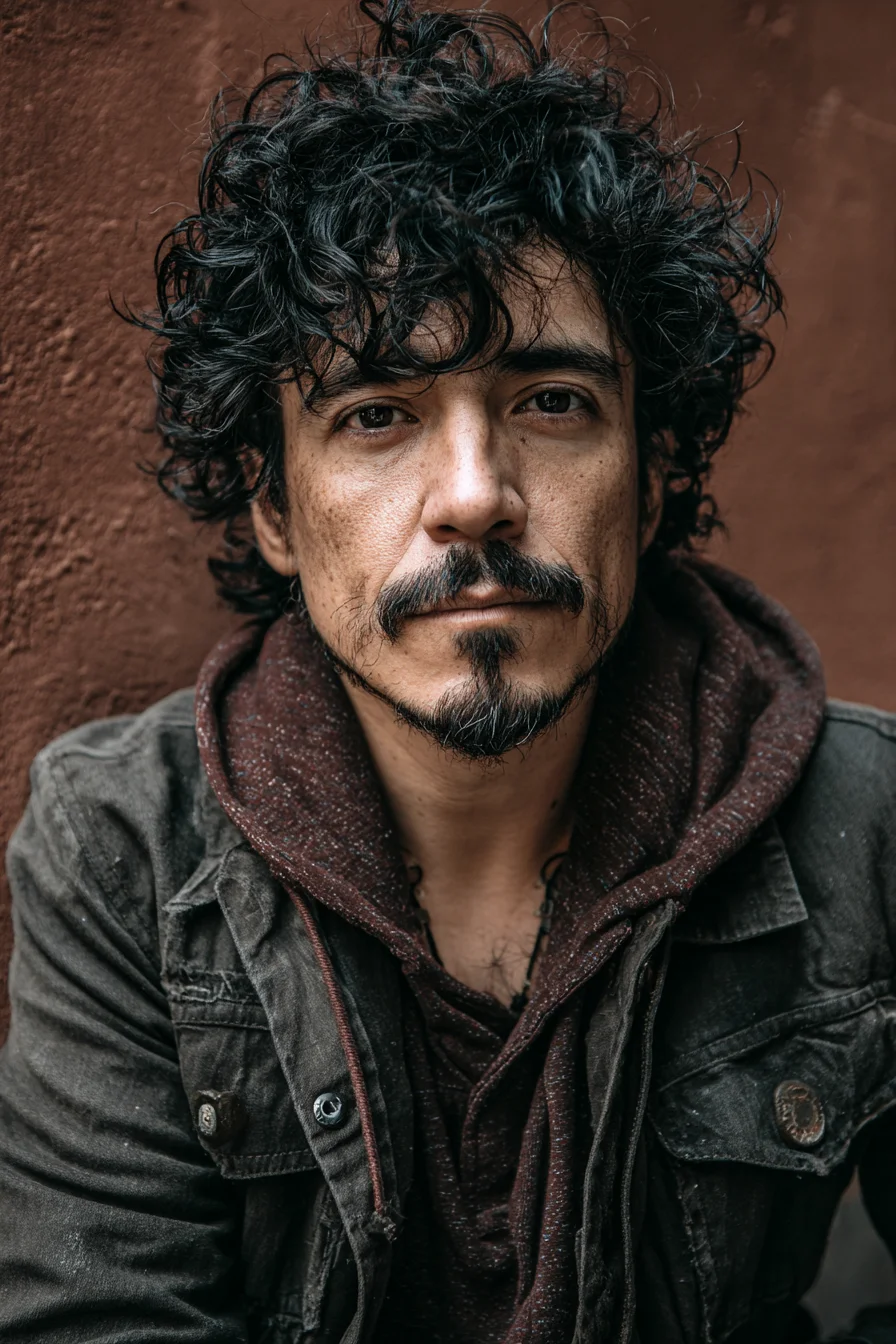
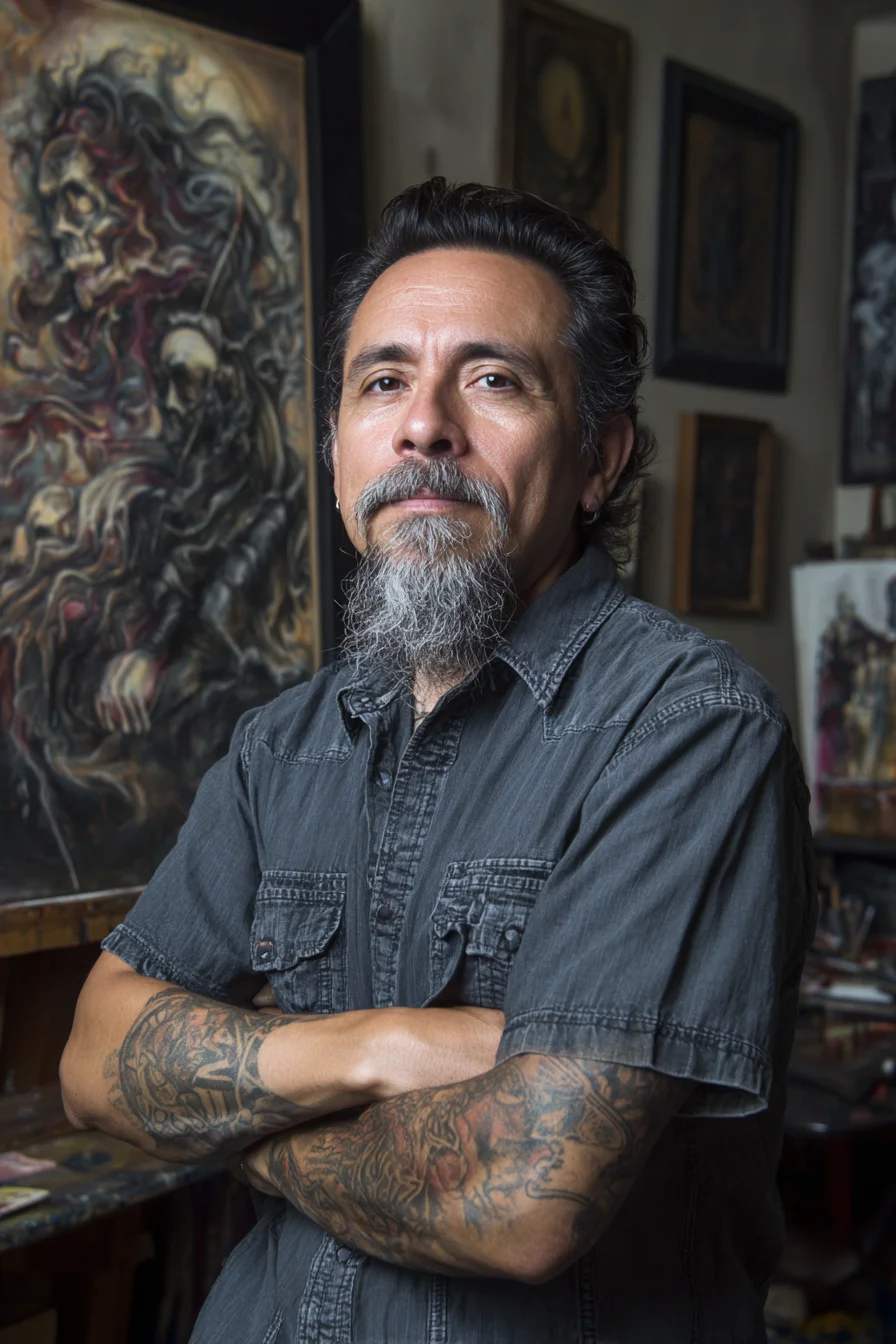
I’m Hakan — a tattoo consultant and designer with 10+ years working across studios and private clients. In this post youll find 32 men tattoos presented with practical guidance to help you choose the right design, placement and artist. I’ve advised first-timers, professionals who need discreet work, collectors building sleeves, and men seeking cover-ups or realism pieces. These images and notes suit a range of tastes: minimalist line work, bold tribal, photorealism, script, neo-traditional, and full-sleeve concepts. Practical tips you’ll get: how to match style to body shape and skin tone, pain and healing expectations per placement, preparing for a session, vetting portfolios, and basic aftercare to protect longevity. Use the 32 curated images as reference — print or save the ones you like, adapt proportions to your anatomy, and book a consultation to customize each idea for lasting results.
Blackwork Compass Sternum Tattoo — Mens Chest Placement & Styling Guide
This compact blackwork compass/mandala design reads as a masculine symbol of direction, resilience and personal values — a strong choice for men wanting a meaningful chest piece without full-sleeve commitment. For placement, the center sternum gives a bold, symmetrical focal point; shifting slightly left places it over the heart for a more intimate feel. Collarbone and upper-chest placements read cleaner with shirts on, while the shoulder cap or inner bicep offers lower-pain alternatives. Expect pain to vary by location: sternum and near ribs are among the most sensitive due to thin skin over bone, collarbones are also notably painful, while the shoulder and upper arm are generally milder. Size considerations: 2–4 inches keeps detail tight and discreet, 4–6 inches allows richer dotwork and geometry, and 6+ inches becomes a dramatic chest piece that follows muscle contours. Styling variations include dense blackwork, fine-line compass with dot shading, geometric negative-space mandala, or a color-infused neo-traditional version. Consult an experienced artist to adapt line weight to your skin type, plan session length, and discuss aftercare and touch-ups for long-term crispness.
Jawline & Submental Linework Tattoo — Minimalist Script and Geometry
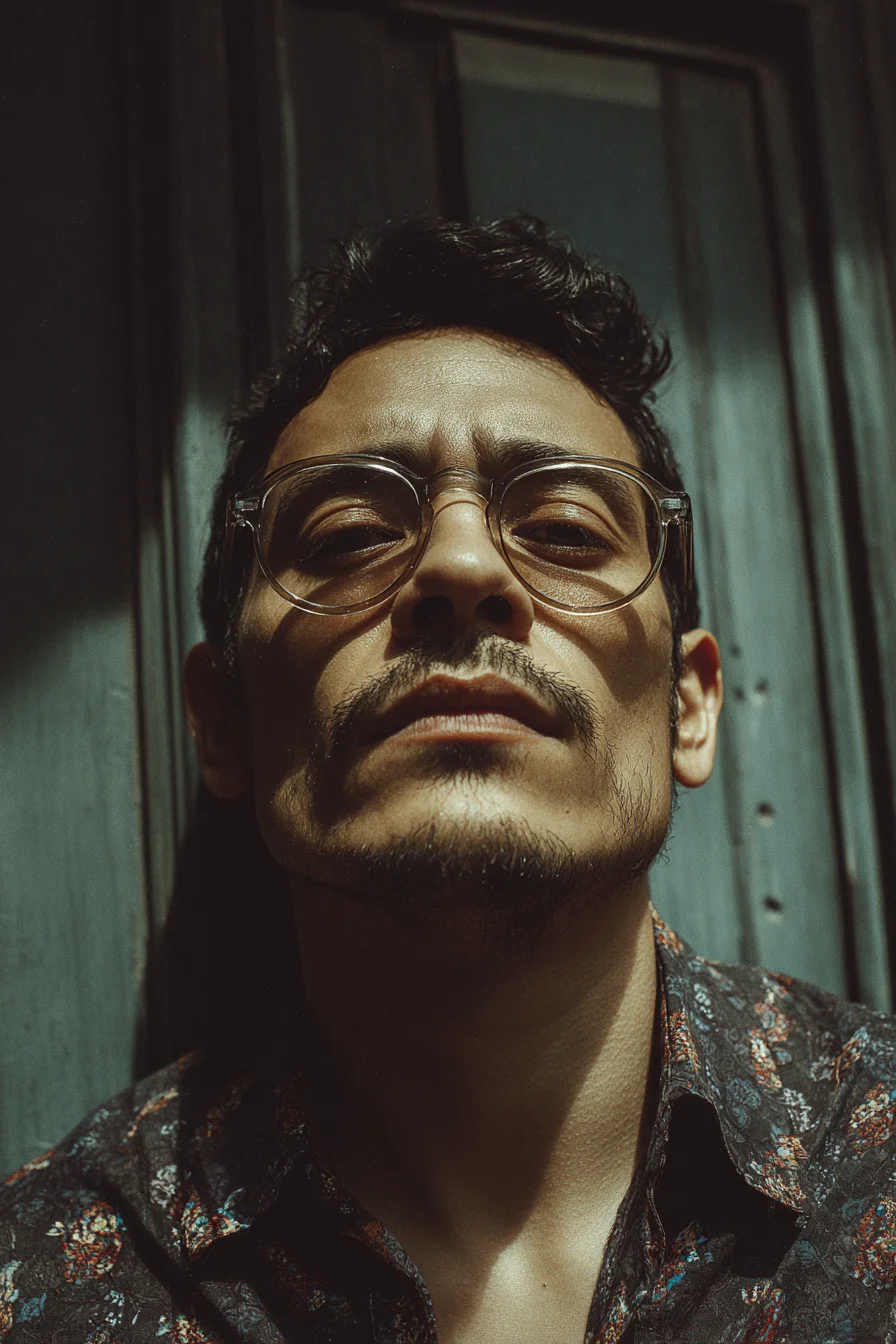
This design focuses on crisp jawline and submental linework to accentuate masculine bone structure and convey confidence with subtlety. Conceptually it reads as strength and precision — a low-key yet intentional accent that follows natural contours rather than dominating the face. Placement suggestions include a slim line tracing the mandible, a small chevron or script tucked under the chin, a short diagonal behind the ear, or a tapered wrap from the jaw into the upper neck; these sit well for men who wear facial hair, as stubble can soften the look. Expect pain levels to range from moderate to high on the jaw and under-chin (thin skin over bone), lower to moderate behind the ear or on the lateral neck, and milder if extended onto the chest. Size considerations: 2–4 cm for a minimalist accent, 5–9 cm for a visible wrap, and 10+ cm if integrating chest/neck panels; line thickness should be adjusted for longevity—very fine lines may blur over time in high-movement areas. Styling variations include single fine-line work, bold blackwork, dotwork shading, micro-script inserts, geometric repeats, or small color highlights. Discuss stencil placement with your artist and plan around beard growth and daily movement for best healing and long-term clarity.
Black & Grey Neo-Traditional Forearm Sleeve — Skull, Wave & Floral Motifs
This black-and-grey neo-traditional forearm design blends skull imagery, flowing wave forms and organic floral elements to convey themes of resilience, transition and balance. The skull reads as a reminder of mortality and strength, waves add motion and adaptability, and the florals provide contrast and a softer counterpoint — ideal for men who want a visually strong piece with layered symbolism. Placement suggestions: a half- or full-forearm sleeve highlights the wrap-around flow and is visible yet easily covered with long sleeves; the same composition also adapts well to upper arm, shoulder cap or calf placements. Pain expectations: outer forearm work is generally moderate; inner forearm and near the wrist/elbow feel sharper and more sensitive—plan for shorter sessions over those zones. Size and detail: maintain at least a medium-to-large scale (roughly 6–10 inches on the forearm) to preserve fine shading and linework over time. Styling variations: keep it pure black-and-grey for timelessness, add selective red or muted color accents for focal points, or convert to a more realistic or dotwork/tribal background to match personal taste. Consult an experienced artist to refine flow, skin-tone contrast and aging considerations.
Masculine Black-and-Gray Sleeve Tattoo — Tribal Elements & Realistic Shading
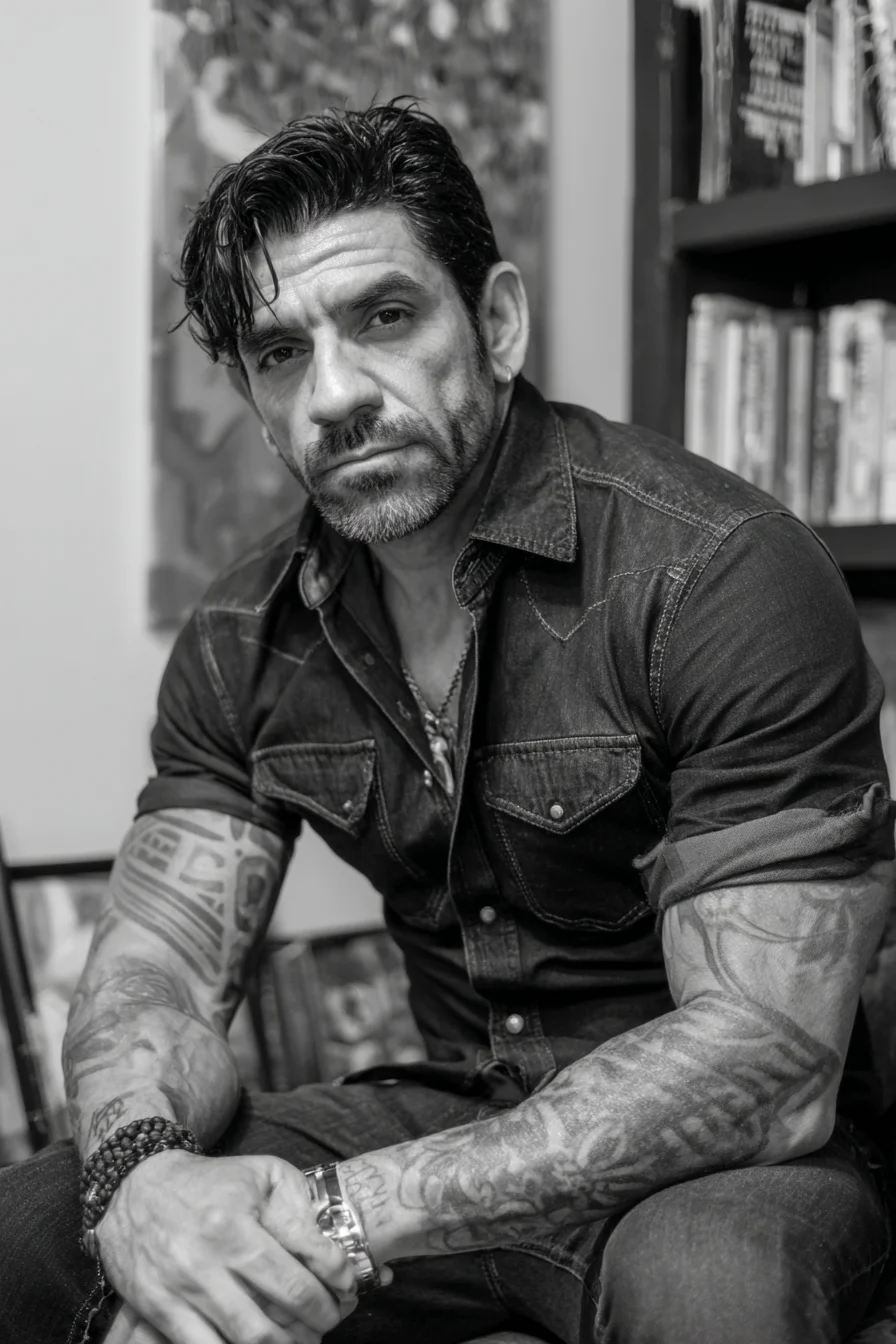
This design reads as a masculine black-and-gray sleeve that combines bold tribal motifs with realistic shading and illustrative elements. Symbolically it conveys strength, heritage and resilience — tribal bands and geometric anchors paired with figurative or script pieces create a balanced narrative across the arm. Placement suggestions: ideal as a full or half sleeve (forearm to bicep), or as a forearm wrap with optional chest or shoulder extension. Inner bicep and wrist additions work well for personal details. Pain expectations: forearm and outer bicep areas are moderate in discomfort; expect higher sensitivity at the inner arm, elbow, and wrist. Sessions and healing time scale with detail and coverage. Size considerations: scale artwork to follow muscle contours — larger panels retain contrast and legibility over time, while very small, dense details can blur; a 6–10 inch composition on the forearm or 10–16 inch full sleeve provides strong visual impact. Styling variations: solid blackwork or high-contrast graywash, minimal color accents (deep reds or muted blues), dotwork fills, or negative-space geometric breaks to modernize the piece and improve longevity.
Blackwork Floral Calf Tattoo — Botanical Bouquet, Fine-Line & Shading
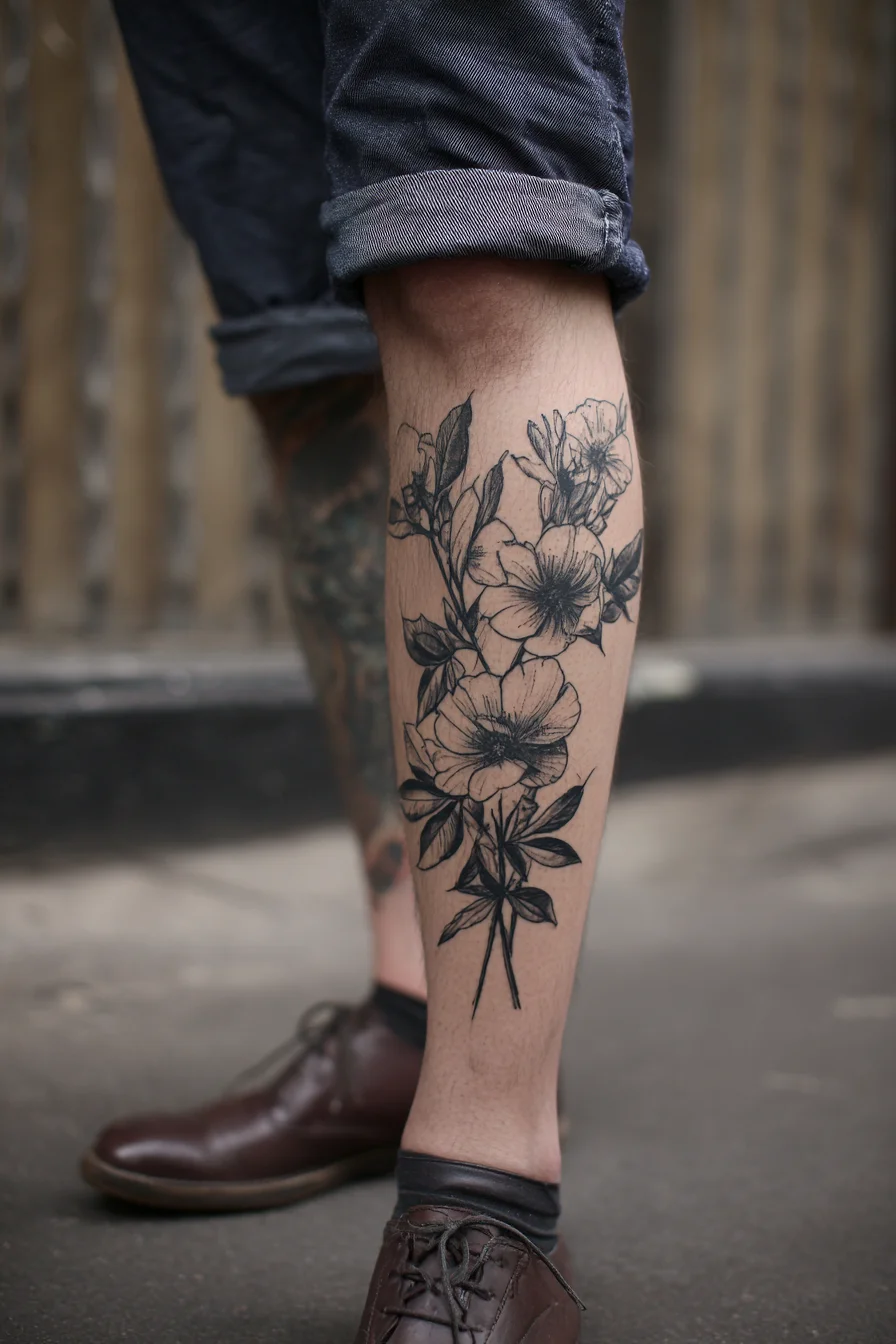
This calf piece is a vertical blackwork botanical bouquet combining fine-line outlines with soft shading — a masculine take on floral imagery that reads as growth, resilience and quiet remembrance. Placement: the outer calf is ideal for visibility and low irritation; it also translates well to the forearm, thigh or chest if you prefer more concealment. Pain expectations: the outer calf is moderate in discomfort; expect sharper sensitivity near the ankle and inner calf. Sessions & size: a mid-to-large vertical composition like this typically requires a single 2–4 hour session, or two shorter sessions for dense shading; plan for a piece roughly 6–10 inches tall to keep petal detail legible. Styling variations: keep the blackwork look for contrast and longevity, or add selective color accents (deep reds/greens) to individual flowers; convert to dotwork or geometric negative-space backgrounds for a more graphic effect. Practical notes: consider hair removal if you want detail to show, and discuss line thickness with your artist to ensure the design ages well on masculine skin tones and muscle contours.
Realistic Black & Grey Portrait Tattoo — Forearm Placement with Watercolor Accents
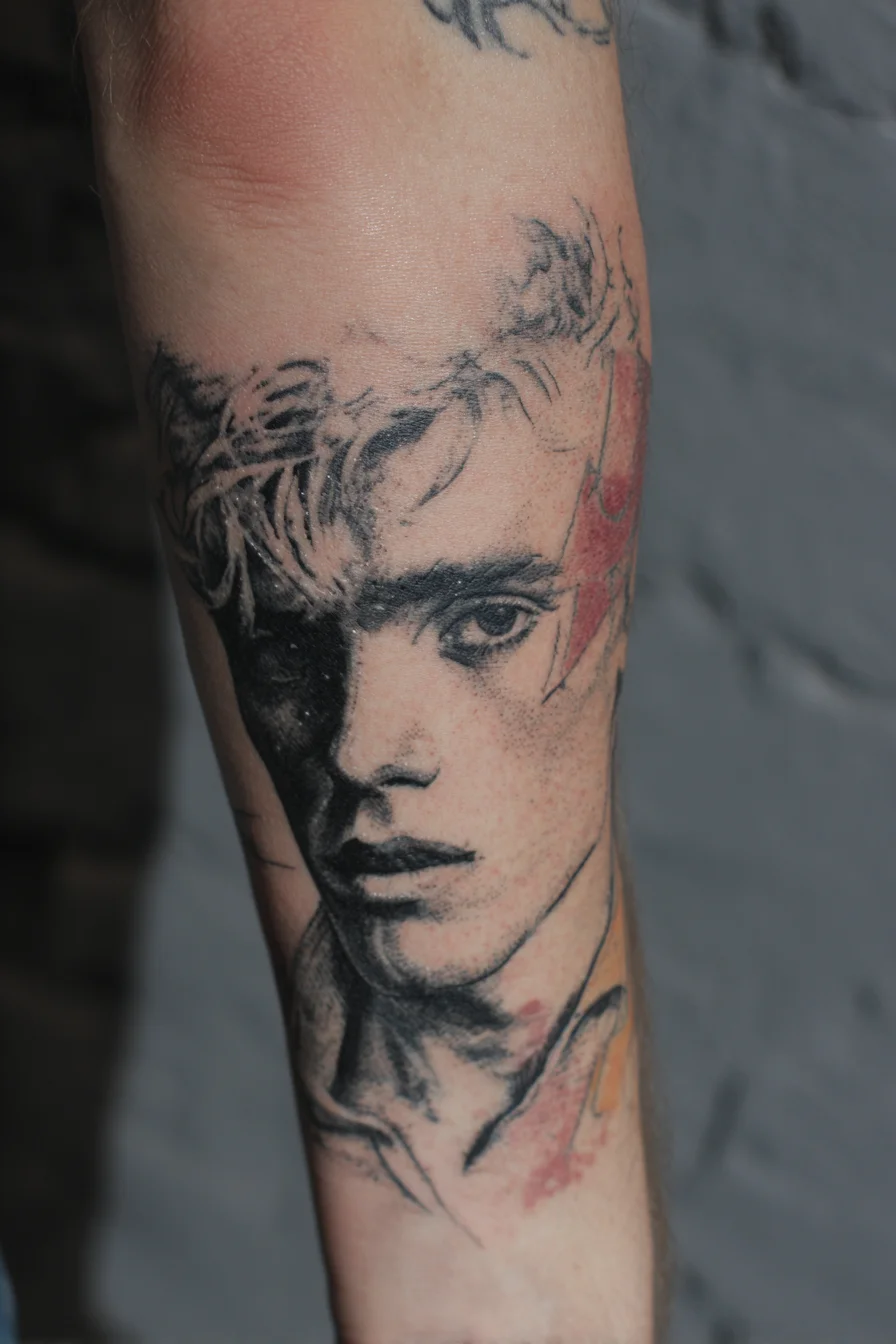
This photorealistic portrait-style design conveys intensity, character and personal narrative — often chosen as a tribute, a representation of identity, or an evocative emotional statement. Executed primarily in black and grey with selective red/orange watercolor highlights, the piece reads well on the forearm where its vertical orientation complements natural anatomy. Placement suggestions: outer or inner forearm for visibility and lower pain, biceps or chest if you want a larger, more private composition, or calf for similar visual impact. Pain expectations: forearm tattoos are generally low-to-moderate in discomfort; the inner forearm and areas close to bone or tendon will feel more sensitive and may require short breaks. Size considerations: portraits need scale to retain facial detail — aim for at least palm-sized (4–6 inches) or larger; finer realism may require a half-sleeve or larger canvas. Styling variations: full black-and-grey realism, sketch/linework overlays, bold watercolor washes, halftone stippling, or geometric framing to modernize the piece. Practical tip: book an experienced portrait artist, bring reference photos, and expect touch-ups to maintain crispness over time.
Calf Mandala Blackwork Geometric Sleeve Tattoo
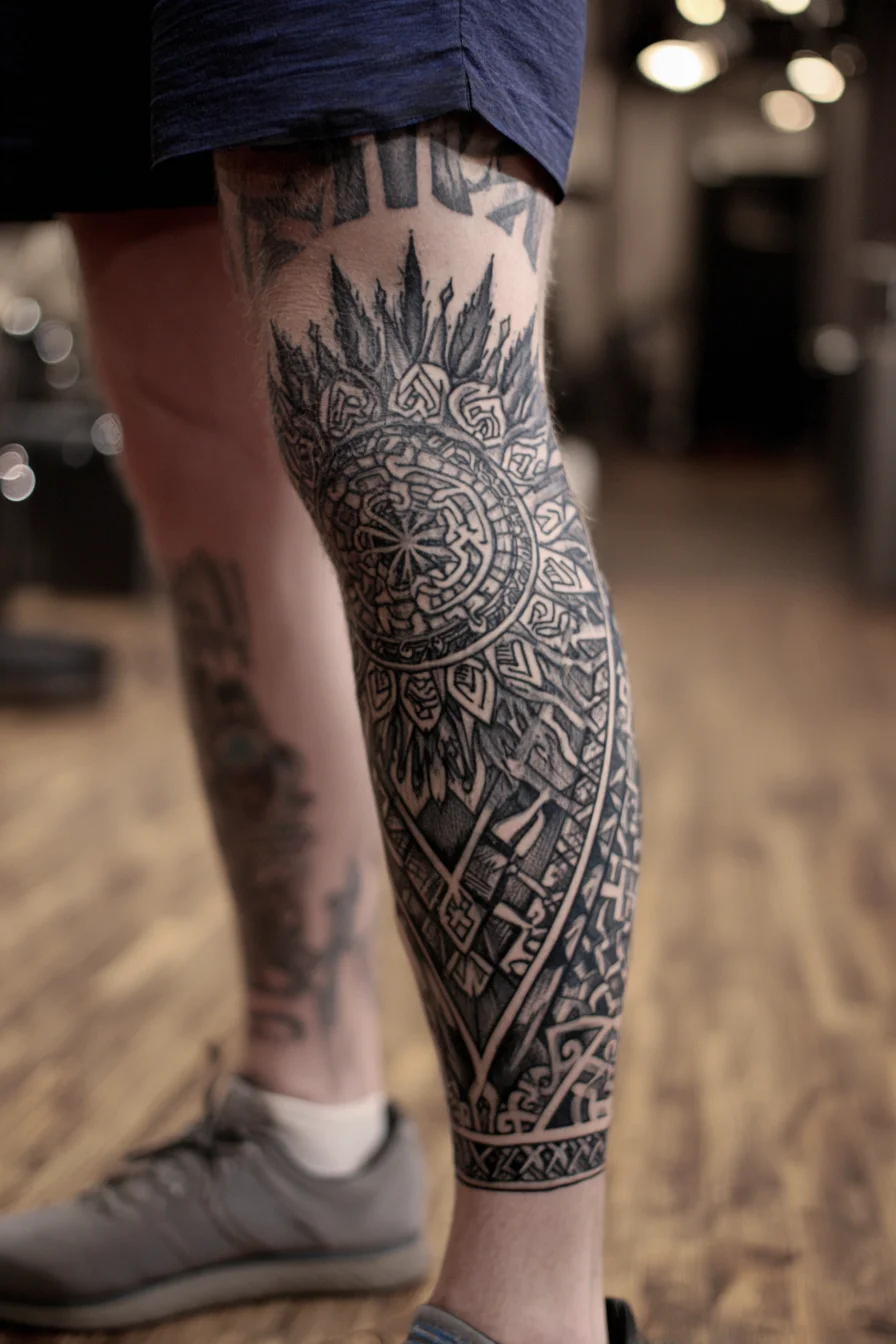
This bold blackwork mandala and geometric sleeve uses a circular focal mandala with radiating rays and interlocking pattern bands to convey balance, protection, and a structured personal narrative. For men seeking a strong, masculine leg piece, the design reads well from a distance while rewarding close inspection with fine linework and dense shading. Placement suggestions: outer calf or full-calf wrap is ideal to preserve the radial symmetry; extend up toward the knee or down over the shin/ankle for a continuous sleeve. Pain expectations: the fleshy outer calf is typically moderate in discomfort, while the shin, ankle and behind-the-knee areas are noticeably more sensitive — expect multiple sessions if you prefer longer sittings. Size considerations: to retain crisp detail, plan for a medium-to-large scale (minimum ~6–8 inches / 15–20 cm on its long axis); full-calf coverage will require 2–4 sessions depending on shading density. Styling variations: keep pure blackwork for high contrast, add grey wash or dotwork for texture, or selectively introduce muted color accents; you can also integrate personal symbols or knotwork motifs to personalize the geometry.
Realistic Aviator Portrait Half‑Sleeve Tattoo — Beard, Goggles & Flying Bird
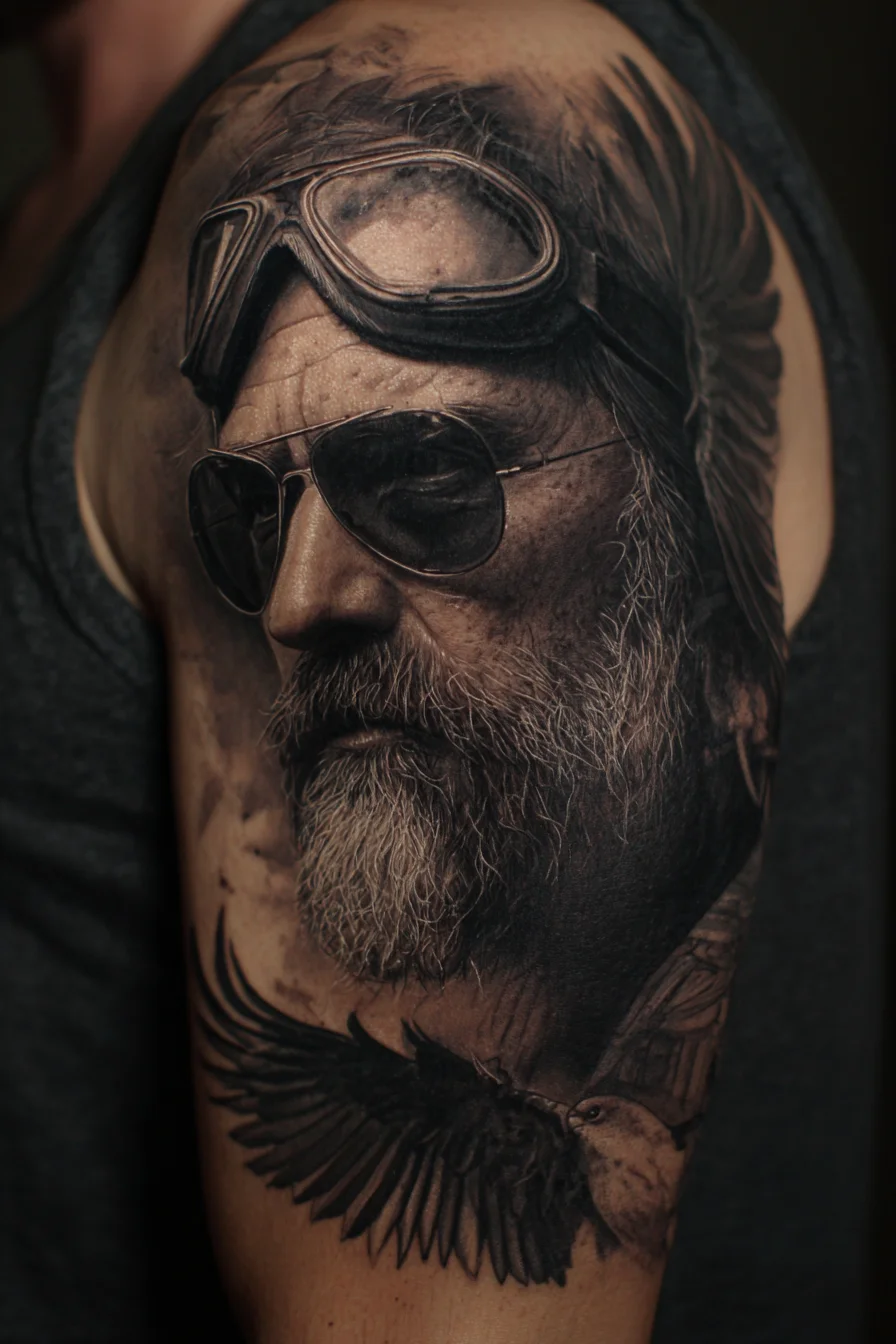
This black-and-grey realistic portrait combines a weathered aviator face with goggles, aviator shades, a textured beard and a dynamic bird/wing motif. The design reads as strength, experience and freedom — a good choice for men wanting a masculine, narrative piece that balances grit with movement. Placement suggestions: the upper arm/shoulder as shown is ideal for a half-sleeve; it also adapts well to a full sleeve, chest panel or back piece for more storytelling elements. Pain expectations: outer upper arm and shoulder are among the more tolerable locations (moderate); expect increased sensitivity near the bony shoulder cap, inner bicep or collarbone and longer sessions when capturing fine hair and facial detail. Size considerations: photorealism needs scale — plan on a minimum of 15–20 cm (6–8 in) in height to preserve facial detail; larger pieces allow deeper contrast and longer-term clarity. Styling variations: keep it strict black-and-grey for classic realism, add subtle selective color (lens reflections or a muted feather), incorporate negative space, geometric framing or script to personalize the narrative and flow into a larger sleeve.
Octopus Skull Forearm Tattoo — Blackwork Nautical Design
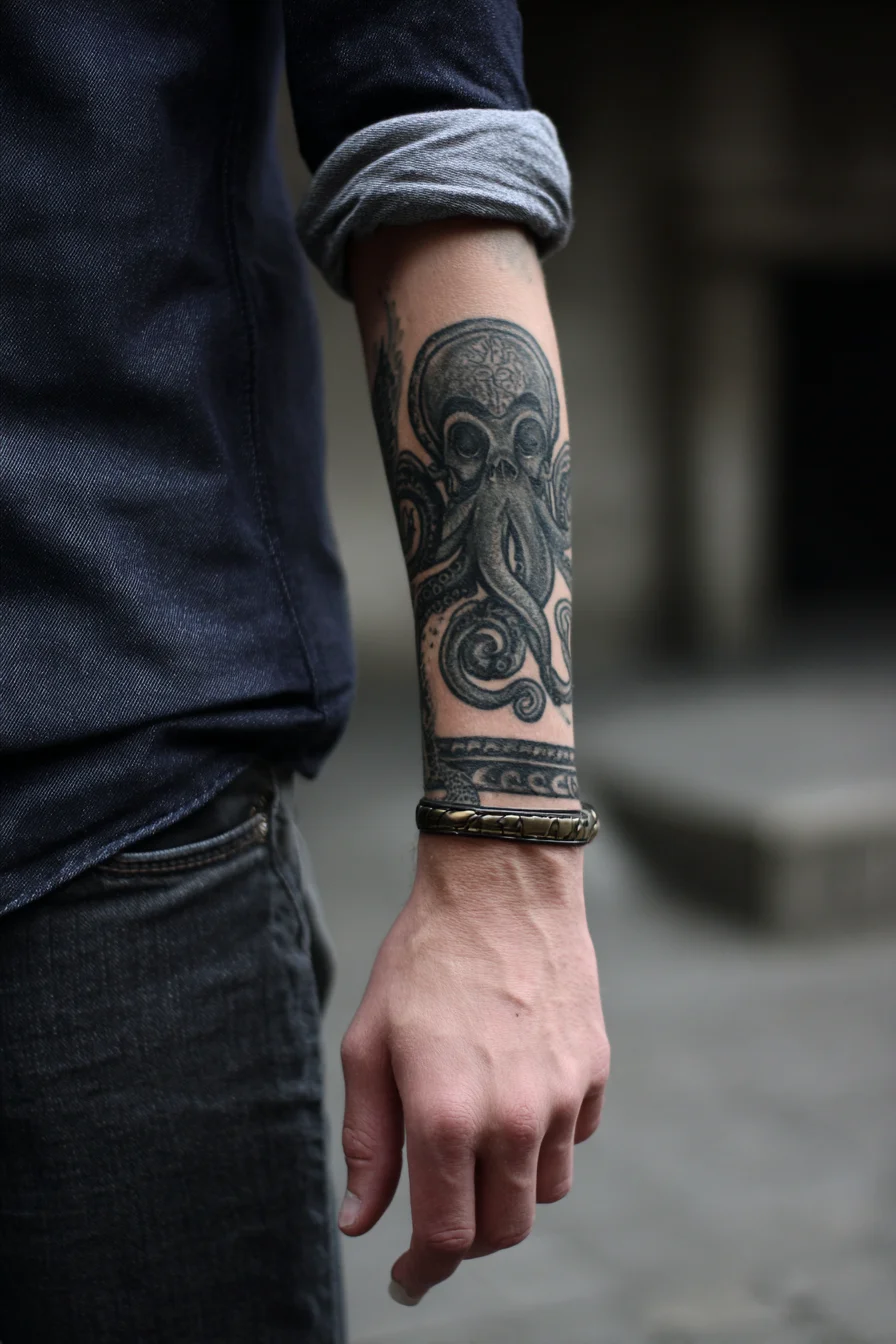
This octopus-skull hybrid blends maritime symbolism with a darker, masculine edge — intelligence, adaptability and the inevitability of mortality. Its flowing tentacles wrap naturally around forearm contours, creating motion and visual depth that reads well both up close and from a distance. Placement suggestions: the outer or inner forearm is ideal for visibility and low-to-moderate pain; the design also scales nicely into a half-sleeve that continues onto the bicep, shoulder or chest for a more aggressive statement. Pain expectations: forearm skin is generally moderate in sensitivity; expect more discomfort near the inner forearm, wrist and elbow. Size considerations: for crisp tentacle detail and skull shading, plan for a medium to large piece (roughly 6–10 inches on the forearm) so linework and dotwork hold up over time. Styling variations: blackwork or heavy dotwork emphasizes contrast and longevity; add neo‑traditional shading for depth, realism for anatomical detail, or geometric/tribal backgrounds to increase masculinity. Discuss line thickness and contrast with your artist to ensure the piece complements existing tattoos and your lifestyle.
Blackwork Ornamental Elephant Calf Tattoo — Geometric Tribal Elephant Head
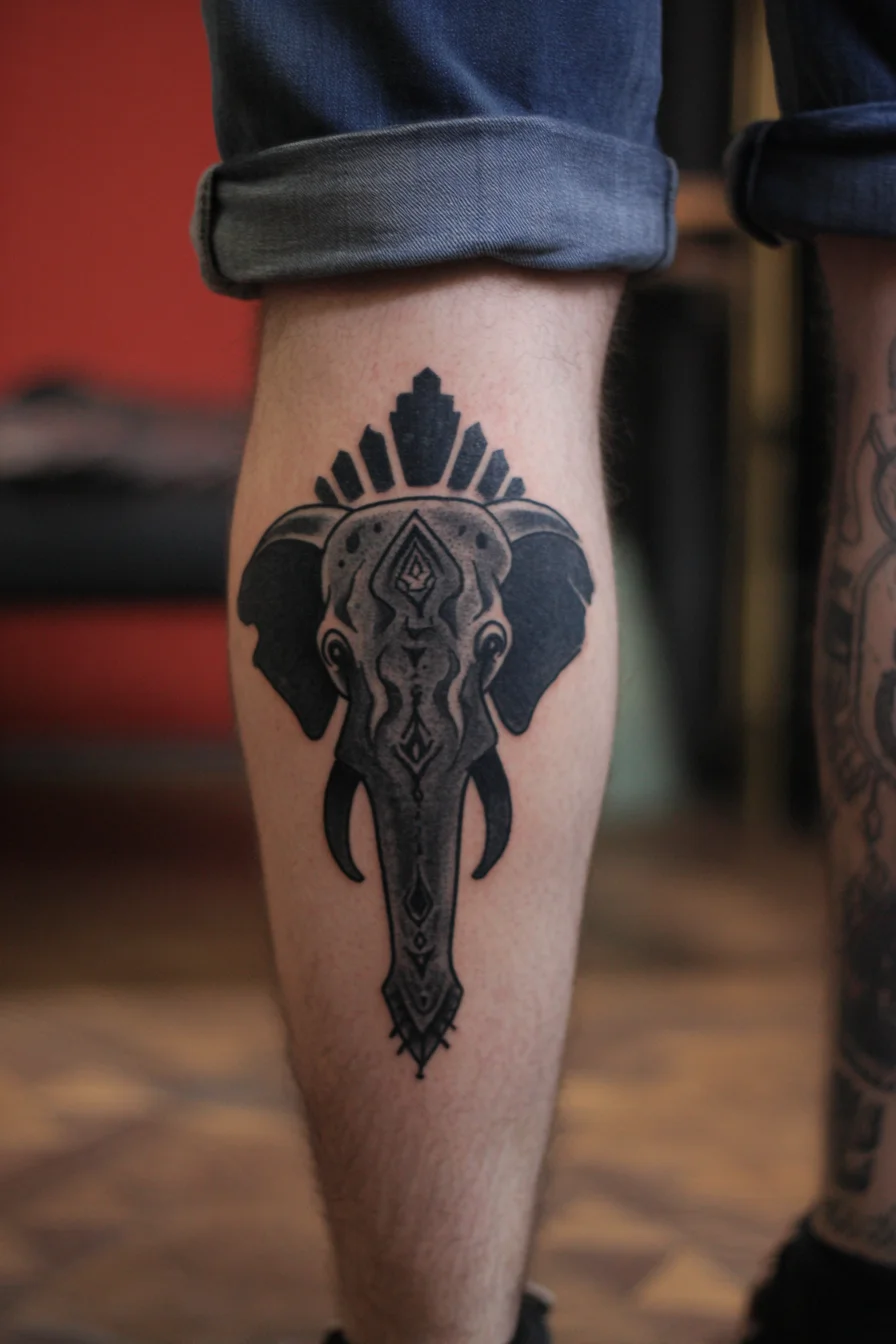
A bold blackwork elephant head with geometric ornamentation reads as a masculine emblem of strength, wisdom and protection. The stylized trunk and crown-like pattern give the design a ceremonial, almost sigil-like quality that works well as a statement piece. Placement: the pictured location on the outer calf provides strong vertical flow and good visibility when wearing shorts; alternatives include the forearm, upper arm, chest or thigh depending on how public you want the piece to be. Pain expectations: calf placement is generally moderate — thicker muscle and skin reduce sharp pain, though the inner calf and ankle areas are more sensitive. Sessions & size: to preserve the ornamental detail plan for a minimum of about 4–6 inches (10–15 cm) in height; smaller reductions will lose fine linework and dotwork. Styling variations: convert to full stippling/dotwork, add subtle color accents (deep indigo, burgundy or gold), move toward realism or neo-traditional linework, or expand the crown into a mandala for a sleeve-friendly layout. Blackwork holds up well over time; expect occasional touch-ups to maintain solid fills and crisp edges.
Bearded Portrait Tattoo — Realistic Blackwork with Compass (Forearm/Calf)
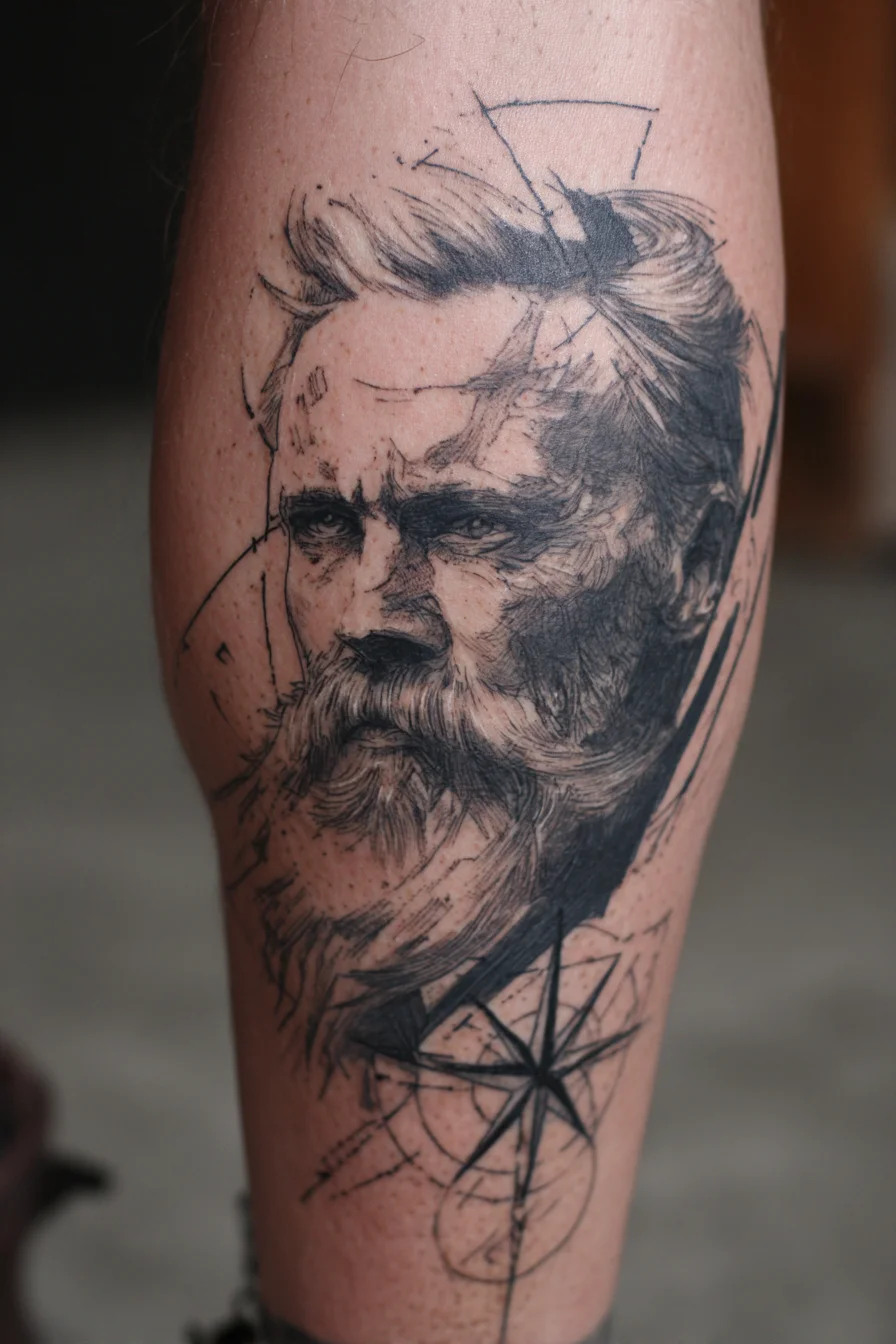
This blackwork sketch-style portrait of a bearded man paired with a compass reads as a symbol of wisdom, resilience and navigation — ideal for men wanting a masculine, story-driven piece. The portrait conveys age and character; the compass adds directional meaning, representing guidance or a life journey. Placement: The design works well on the outer forearm (as shown) or on the calf for vertical display. It also scales to the upper arm, shoulder blade, or integrated into a sleeve or chest panel. Pain expectations: Expect low-to-moderate discomfort on fleshy outer forearm and calf. Inner forearm, ribs, sternum and bony shoulder areas are significantly more sensitive. Size considerations: To retain facial detail, plan for a medium-large piece — roughly 15–25 cm (6–10 in) tall. Smaller sizes will lose fine texture and linework. Styling variations: Keep it monochrome blackwork for a rugged, timeless look; add subtle grayscale realism, dotwork shading, or watercolor accents for contrast. Consider surrounding elements — ships, waves, anchors, geometric lines or script — to personalize narrative and balance composition. Discuss sizing and placement with your artist and allow time for touch-ups during healing.
Japanese Chrysanthemum Full Sleeve Tattoo — Bold Blackwork Floral Sleeve
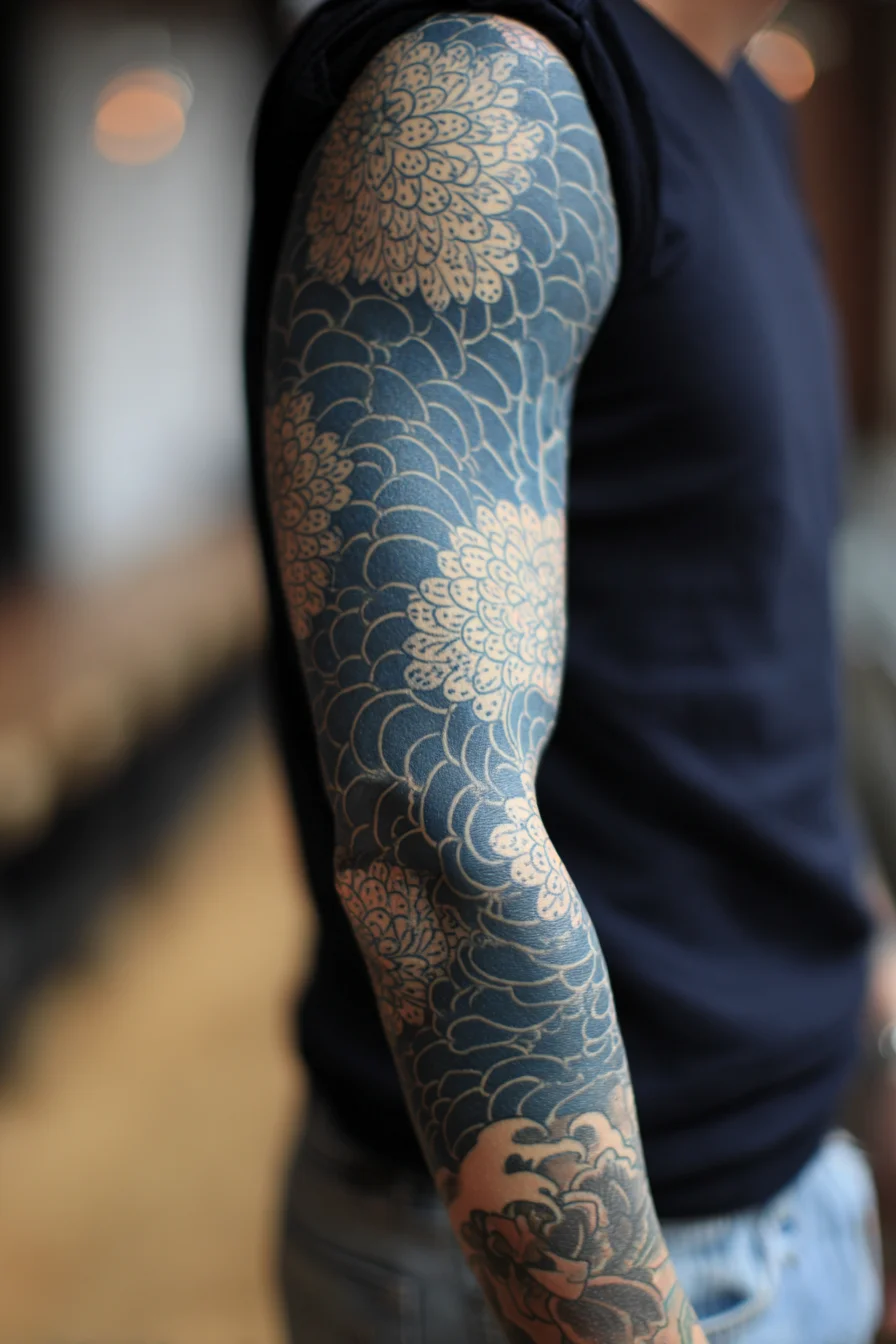
This full-sleeve design centers on chrysanthemum motifs layered over a dark, scale-like blackwork background — a classic Japanese-inspired composition that reads strong and disciplined on the arm. Meaning: chrysanthemums traditionally symbolize longevity, rejuvenation, and noble character; combined with the protective, flowing background, the piece conveys resilience and enduring presence. Placement suggestions: best executed as a full or three-quarter sleeve (shoulder to wrist or shoulder to elbow) where the repetition and negative space can wrap the musculature — outer bicep and deltoid are lower-pain, highly visible choices; consider connecting to the chest or back for a cohesive body suit. Pain and sessions: heavy blackwork requires multiple long sessions; expect moderate pain on fleshy outer areas but increased sensitivity at the inner bicep, elbow crease, and wrist. Size and detail: design needs larger scale to preserve petal and pattern detail — avoid shrinking this motif below forearm size or detail will blur. Styling variations: introduce gold/yellow or red highlights for the chrysanthemums, greywash shading for depth, or pair with koi, waves, or geometric elements; keep bold lines for longevity and to suit a masculine aesthetic.
Roaring Tiger Back & Neck Tattoo — Bold Neo-Traditional Mandala Design
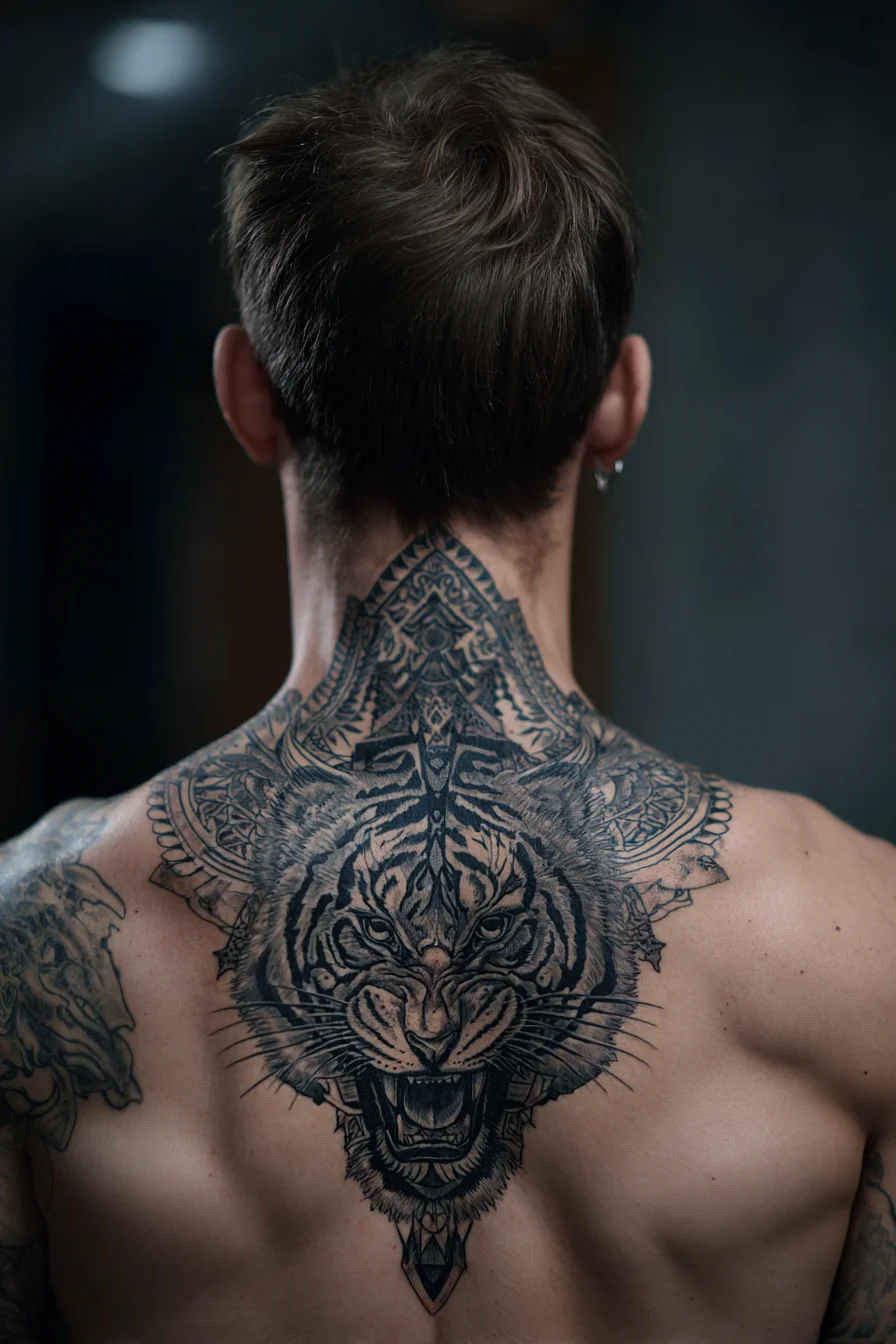
This bold tiger head centered on the upper back and nape reads as a classic symbol of strength, protection and controlled aggression — ideal for men seeking a statement piece that communicates confidence. The composition blends realistic fur and facial detail with ornamental mandala elements, giving it both raw energy and structured symmetry. Placement suggestions: a full upper-back piece that extends up the spine to the nape and across the shoulder blades works best to preserve facial detail; variations can wrap onto the chest, shoulders or form a half-sleeve transition. Pain expectations: expect higher sensitivity along the nape and spine (7–9/10), moderate discomfort on the shoulder blades and trapezius (4–6/10), and lower pain on fleshy mid-back areas (3–5/10). Size considerations: this design benefits from a large canvas — think full upper-back (10–12+ inches / 25–30+ cm) to retain fine linework; scaling down will reduce facial detail and mandala intricacy. Styling variations: black-and-grey realism (as shown), high-contrast neo-traditional color, geometric/tribal framing, or dotwork mandala expansions. Plan multiple sessions and standard aftercare to ensure crisp, long-lasting results.
Black & Grey Realistic Female Portrait with Rosary Tear — Forearm Tattoo
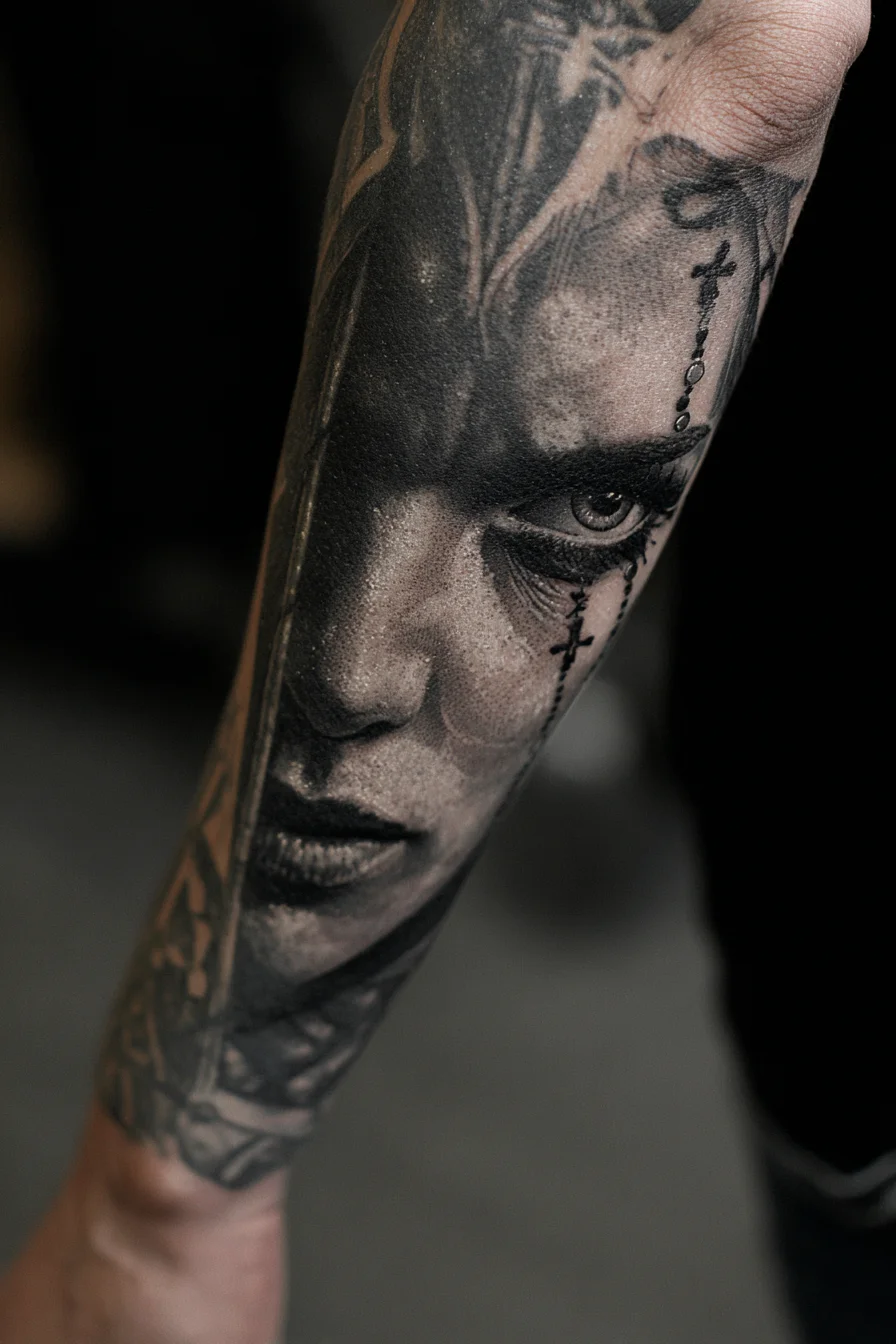
This black-and-grey realistic portrait features a haunting female face with a rosary or cross tear line — a design that reads as resilience, faith, mourning or guarded vulnerability depending on personal context. For men considering this piece, the forearm shown is ideal for visibility and storytelling: outer forearm for lower pain and everyday display, inner forearm for a more intimate placement, or extended into a half/ full sleeve to create a cohesive narrative. Expect pain levels to be moderate overall; outer forearm sessions are tolerable, while areas near the wrist, inner elbow and bony ribs will be noticeably more sensitive. To preserve the fine detail of eyes, skin texture and tiny crosses, plan for a medium-to-large canvas — typically 6–10 inches or larger — and multiple sessions with a skilled realism artist. Styling variations include high-contrast black-and-grey, softer dotwork blends, selective color accents (subtle red or sepia), or framing with geometric/ornamental elements and script. Discuss ink density and skin tone adaptation with your artist to ensure contrast longevity and crisp detail as the piece ages.
Classical Bearded Portrait — Blackwork Calf Tattoo | Mythic Head Design
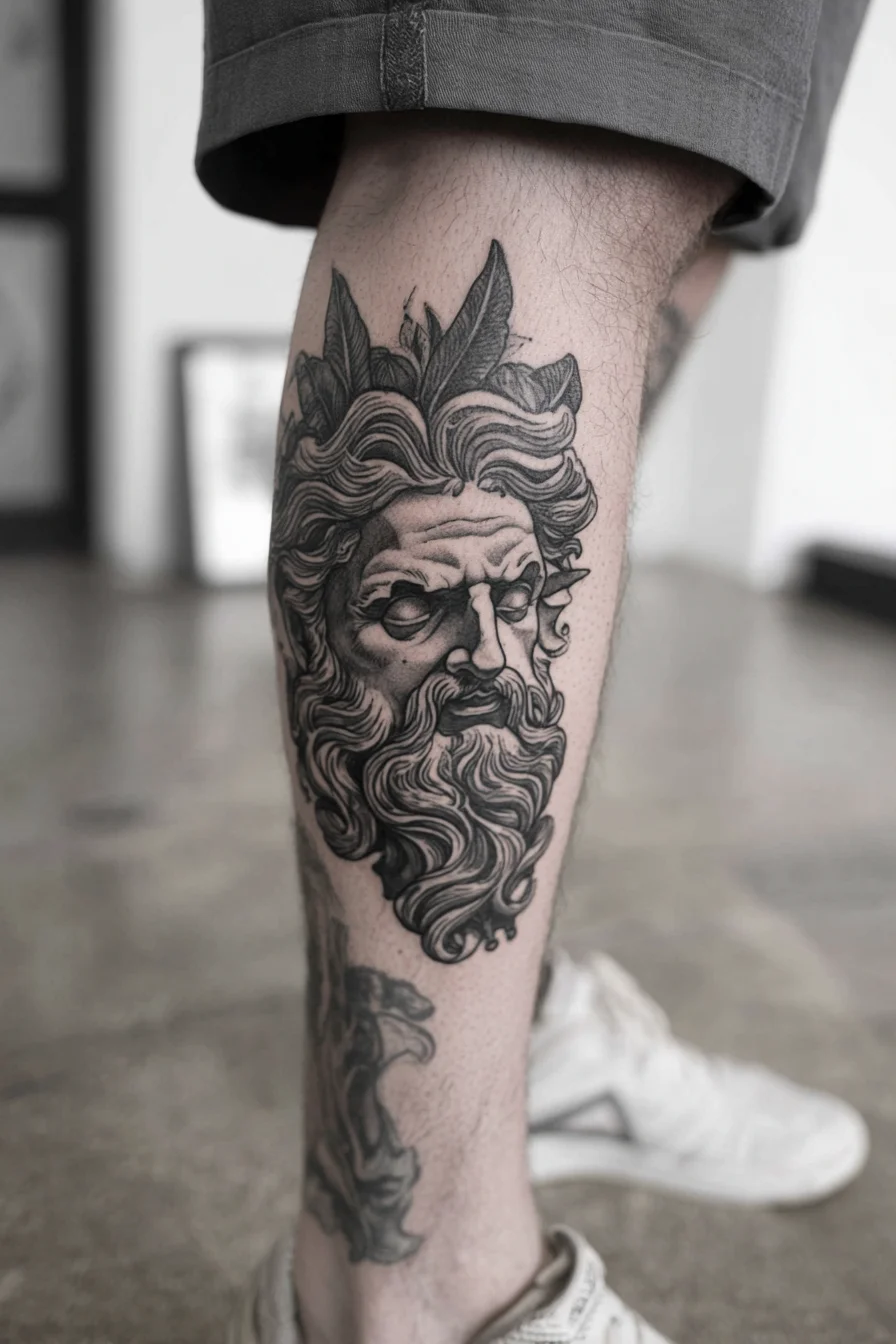
This classical bearded head in bold blackwork reads as a timeless symbol of strength, wisdom and stoic masculinity. The laurel-like leaves and flowing beard give it a mythic, statue-inspired presence without tying it to a specific figure, making it a versatile personal emblem. Placement suggestions: the outer calf (as shown) is ideal for vertical compositions and lets the design follow natural muscle lines; alternatives include the upper arm, chest, thigh or full forearm for greater visibility. Pain expectations: the calf is generally moderate — outer calf and fleshy areas are more comfortable, while the inner calf and near the shin are noticeably sharper. Size considerations: to preserve facial detail and textured shading, plan for a medium-to-large piece (roughly 6–10 inches / 15–25 cm); smaller versions will lose fine linework and depth. Styling variations: full blackwork or grayscale realism for a classical look, dotwork shading for a softer texture, neo-traditional lineweight for bold contrast, or selective color accents (gold or green) to highlight the leaves. Discuss session timing, layering for depth, and touch-up plans with your artist for best long-term results.
Viking Warrior Realism Forearm Tattoo — Norse Helmet Portrait
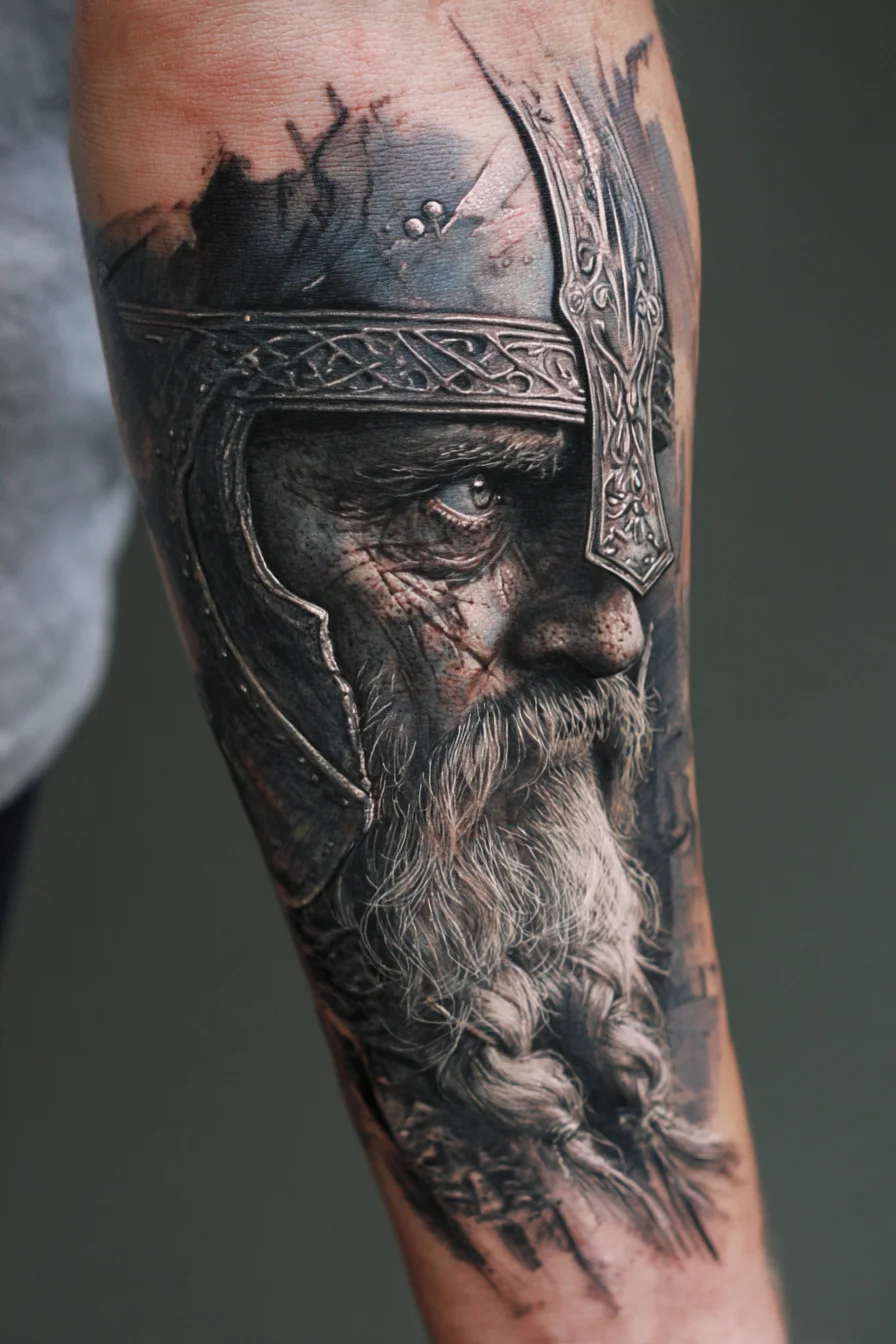
This hyper-realistic Viking portrait captures age, battle-worn wisdom and stoic resilience — a design that signals strength, heritage and a warrior mindset. Ideal for men who want a bold, narrative focal piece, the detailed helmet, scarred skin and braided beard read strongly in black-and-grey portraits. Suggested placements: outer forearm (as shown) for visibility and moderate pain, full or half sleeve for continuity, upper arm, chest or calf if you prefer a larger canvas. Pain expectations: outer forearm and upper arm are low-to-moderate; inner arm, ribs, sternum and ankle will be noticeably more painful. Size considerations: realism requires scale — plan for at least forearm-length or half-sleeve dimensions to preserve fine texture, highlights and facial detail. Expect multiple hours — commonly 4–8+ hours split across 1–3 sessions depending on size and color. Styling variations: pure black-and-grey realism with white-ink highlights, selective color accents (eye or blood), integrated Norse knotwork borders, or a blended sleeve using dotwork and geometric framing. Consult your artist for custom sizing, skin-tone adjustments and a realistic session and aftercare plan.
Realistic Bearded Sailor Portrait Tattoo — Black & Grey Forearm Design
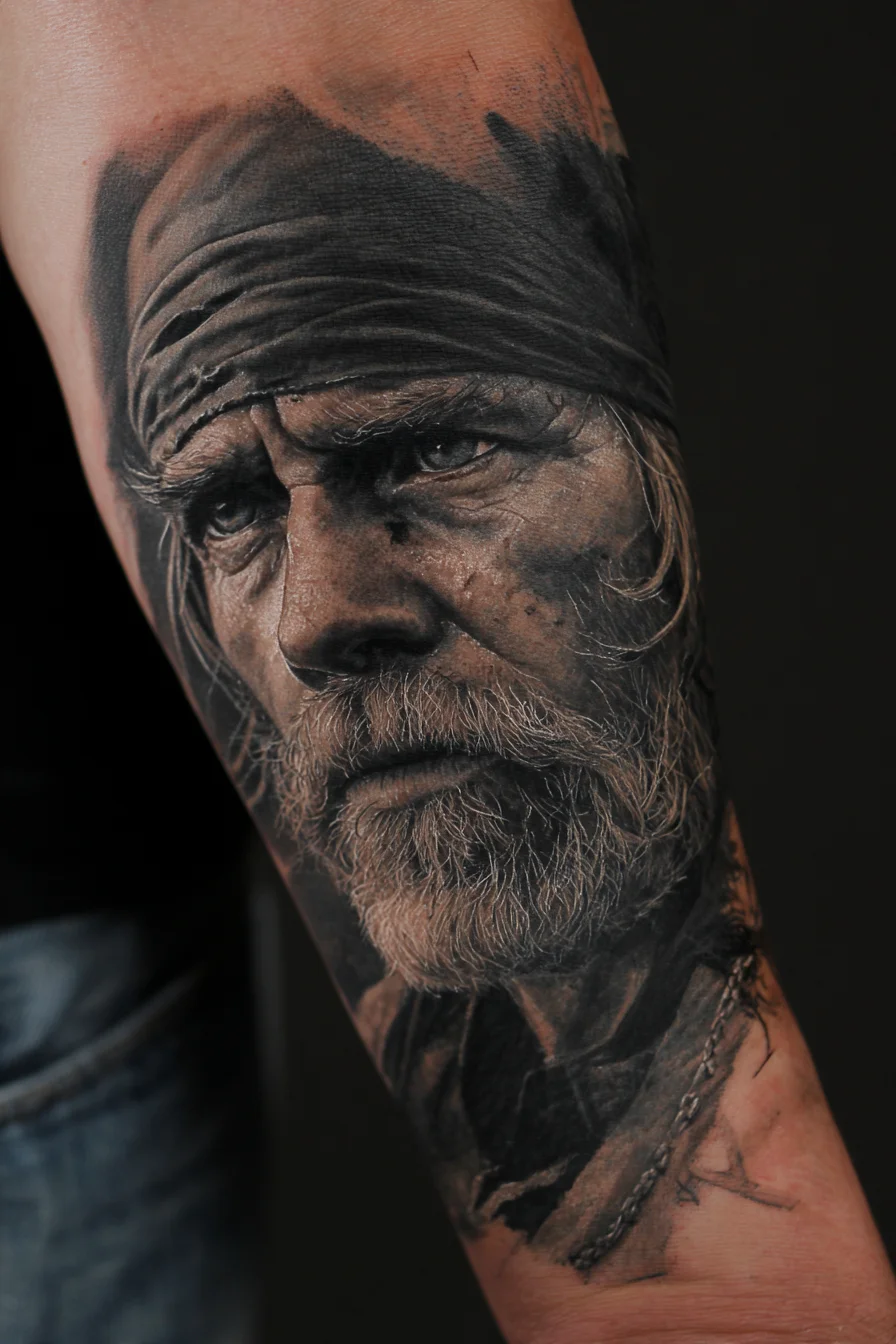
This realistic black-and-grey portrait of a weathered, bearded man wearing a headband evokes resilience, lived experience and rugged masculinity. It reads well as a tribute piece — to a mentor, a seafaring archetype, or a personal story of endurance — because of the expressive eyes, textured skin and detailed beard. Placement suggestions: best on the outer or inner forearm, as a half or full sleeve element, upper arm, chest panel or calf where vertical composition and fine detail are preserved. The outer forearm is easy to show or conceal during work. Pain level expectations: anticipate low–medium discomfort on the outer forearm, medium on the inner forearm and upper arm; ribs, sternum and joint areas (elbow, knee) are notably more painful. Portraits require long sessions, so discuss breaks with your artist. Size considerations: to retain photorealistic detail aim for at least 6–10 inches (15–25 cm) in height; anything smaller will lose fine hair and skin textures over time. Styling variations: stick with high-contrast black-and-grey, or add selective color highlights (blue eyes, warm skin tones), nautical motifs (compass, rope) or integrate into a sleeve. Work with a portrait specialist and expect touch-ups and aftercare (sun protection, moisturizing) to maintain contrast.
Black Dragon Forearm Tattoo — Oriental Blackwork Neo-Traditional
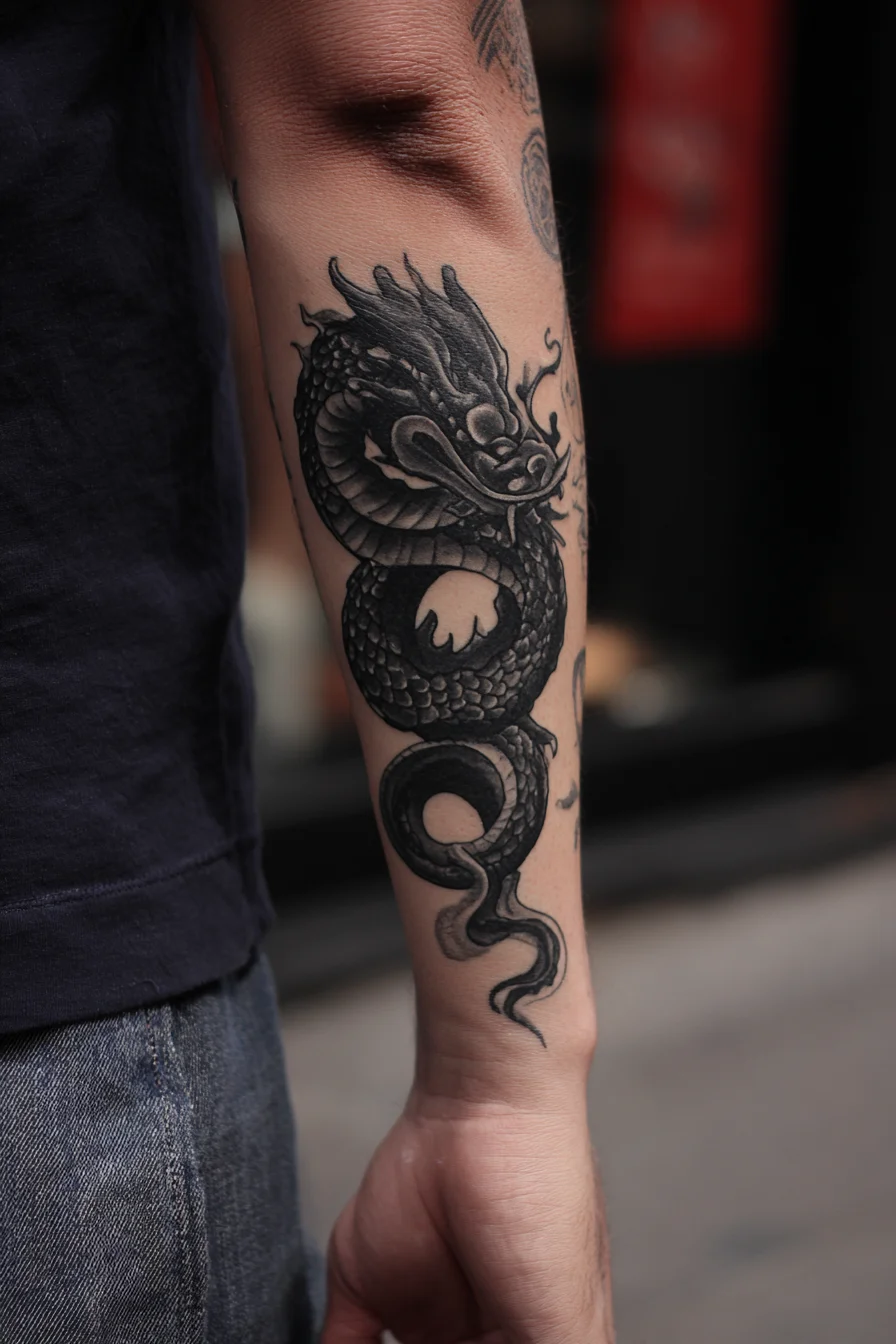
This bold black dragon design blends Oriental iconography with neo-traditional blackwork, symbolizing strength, protection, and personal transformation. The coiled composition and heavy scale shading read strongly on the forearm, giving a masculine, aggressive silhouette that works well for men who want a statement piece. Placement suggestions: ideal for the inner or outer forearm where the elongated dragon follows the arm’s natural line; consider wrapping the tail slightly around the wrist or continuing into a half-sleeve on the bicep for a cohesive flow. Pain expectations: the forearm is generally moderate — inner forearm is softer and more sensitive, while the outer forearm is less painful; expect increased discomfort over the wrist and near the elbow. Size considerations: keep this design at least medium-sized (6–10 inches / 15–25 cm) to preserve scale texture and facial detail; very small reductions will lose definition. Styling variations: solid blackwork as shown, add selective color accents (red, gold), convert to full traditional Japanese irezumi with waves and cloud backgrounds, or simplify into dotwork/linework for a more modern look. Discuss session length and aftercare with your artist for optimal healing and contrast retention.
Realistic Bearded Elder Portrait Tattoo — Black & Grey Forearm Sleeve
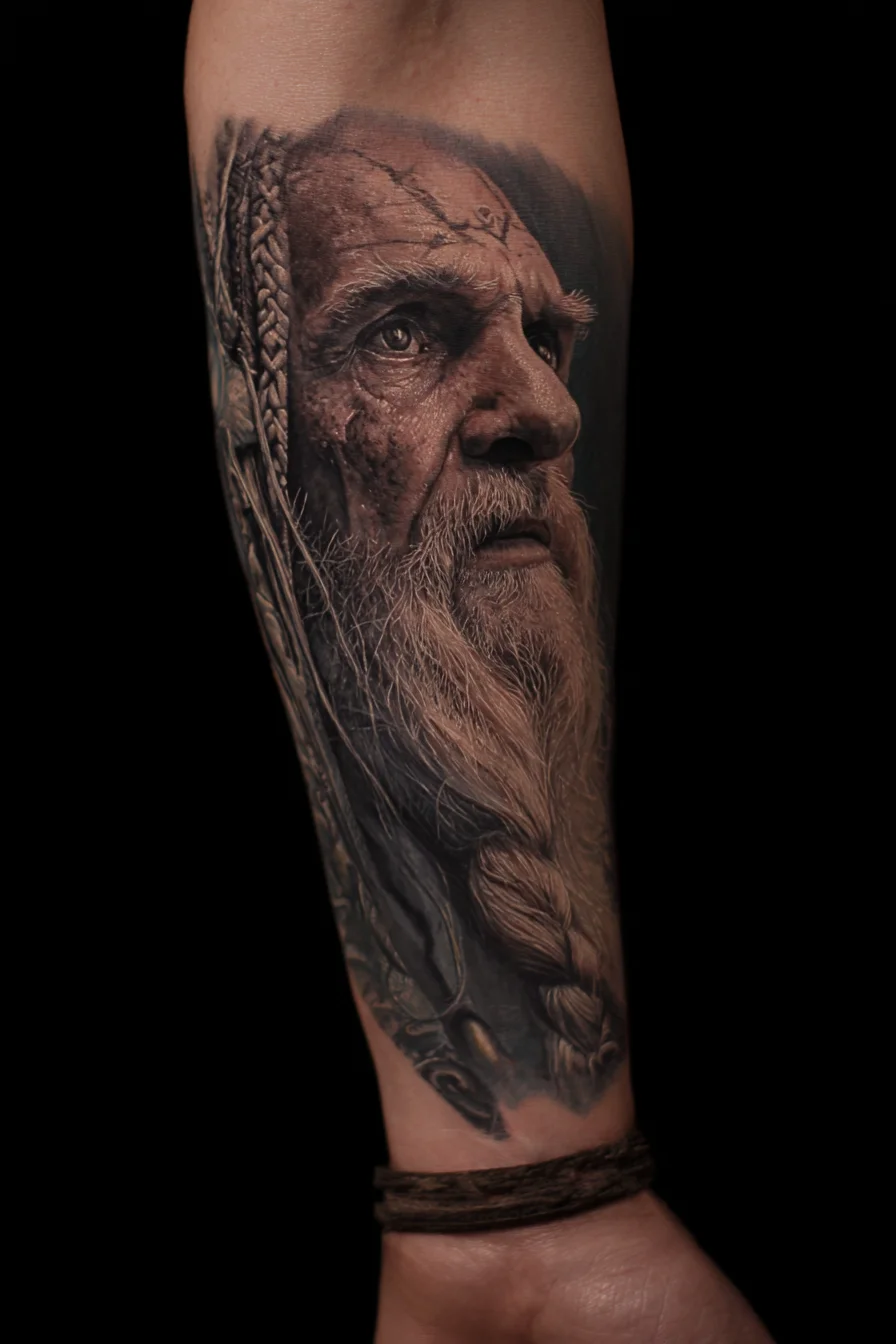
This hyper-realistic black & grey portrait of a bearded elder reads as a symbol of wisdom, resilience and ancestral or Norse-inspired identity. The weathered face and braided beard work together to convey narrative and character, making it a strong choice for men who want a statement piece with emotional weight. Placement: ideal on the outer forearm as shown for visibility and flow; it also translates well to a full or half sleeve, upper arm, chest panel or calf where curvature can enhance the portrait. Pain expectations: outer forearm is generally low–moderate; inner forearm, elbow crease and wrist areas are more sensitive; ribs, sternum and ankle are higher-pain locations. Size considerations: for crisp facial detail plan on a large canvas — typically at least 6–8 inches (15–20 cm) vertically; full sleeve sizes offer the best long-term legibility. Styling variations: keep pure black & grey realism, add selective color washes (warm sepia or cool blue), frame with knotwork or runic borders, or combine with dotwork/background texture. Practical notes: book a realism specialist, anticipate multiple 3–6 hour sessions, and plan for routine touch-ups and diligent aftercare (sunscreen, moisturizer) to preserve detail.
Black & Grey Greco‑Roman Bust Tattoo — Realistic Forearm Portrait
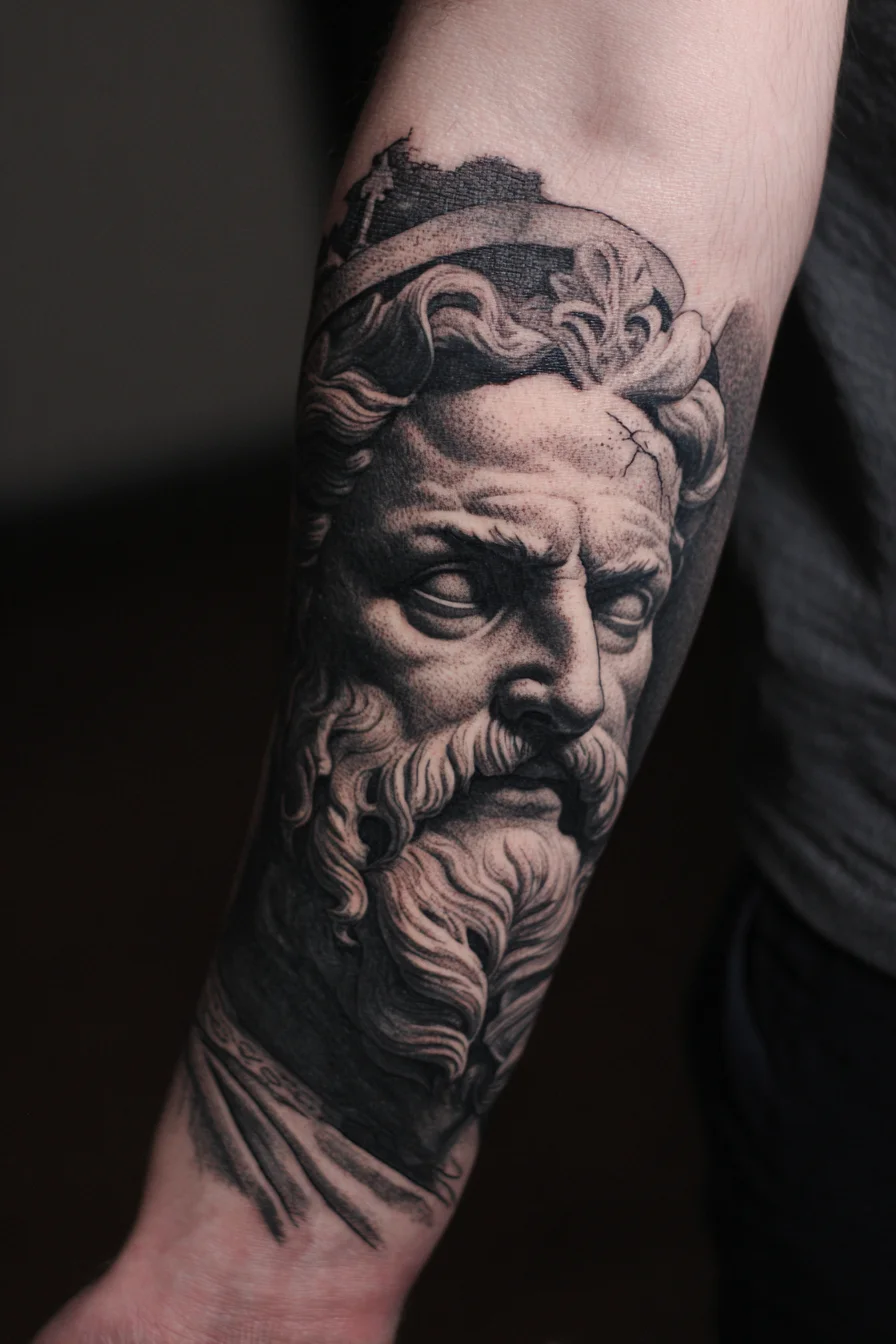
This black and grey realistic bust evokes classical themes—strength, wisdom and stoic endurance—making it a strong choice for men who want a timeless, masculine statement. The cracked marble effect suggests resilience and history, while the detailed beard and hair create natural flow that complements arm musculature. Placement suggestions: the forearm (inner or outer) showcases the vertical composition and allows easy visibility; the same design also adapts well to the upper arm, chest, or as part of a half- or full-sleeve. Pain expectations: forearm tattoos are generally low-to-moderate in pain; the outer forearm is milder, while the inner forearm and near the elbow or wrist can feel more sensitive. Size considerations: to preserve the fine facial shading and texture, plan for a medium-to-large piece (6–12 inches) — reducing scale will lose subtle highlights and dotwork. Styling variations: keep it strict black-and-grey realism, add stippling for texture, combine with geometric frames or olive laurels, or introduce subtle color washes (deep blues/sepia) for contrast. Work with an experienced portrait artist to retain expression and fine detail.
Photorealistic Portrait Forearm Tattoo with Geometric Fragmentation & Gold Accents
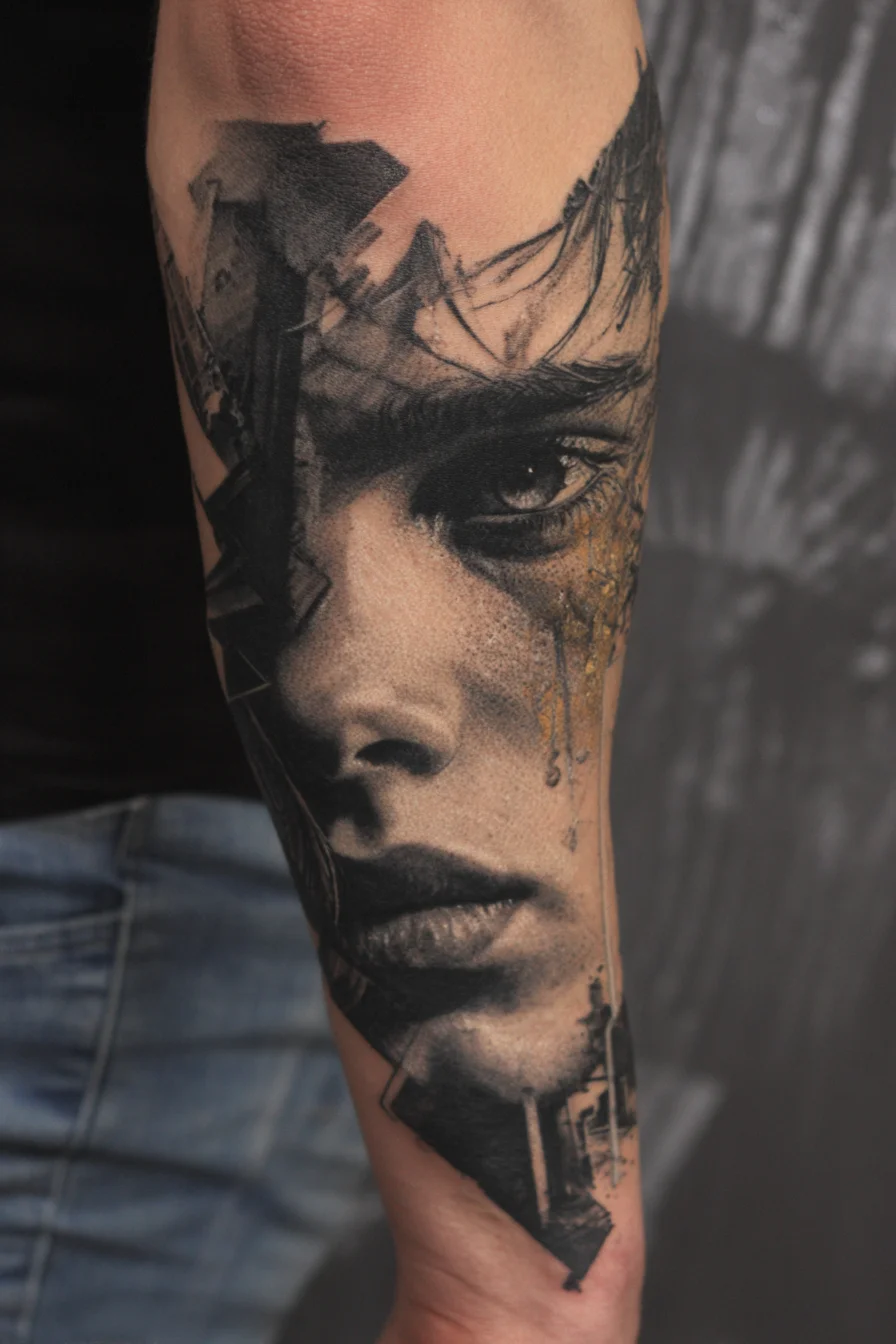
This tattoo mixes high-detail black-and-gray portraiture with abstract geometric breaks and selective gold highlights to create a mood of introspection, resilience and fractured identity. The realistic eye and facial shading draw attention while the jagged overlays give the piece a masculine, architectural edge—gold or warm metallic ink is used sparingly to suggest repair or focal contrast. Placement suggestions: the outer or inner forearm shown here suits the piece well for visibility and lower pain; it also adapts to a full sleeve, upper arm, chest panel, thigh or calf if integrating into larger work. Pain expectations: forearm placement is generally low-to-moderate in discomfort; expect more sensitivity around the wrist, elbow crease and inner bicep, and much higher pain on ribs or sternum. Size considerations: photoreal detail needs scale—plan for at least a medium canvas (6–10 inches) to preserve facial nuance; larger sizes allow finer texture and smoother gradients. Styling variations: full black-and-gray realism, added muted color washes, heavier geometric/glitch overlays, dotwork backgrounds or negative-space framing. Consult a realism specialist for stencil placement and shading strategy to retain lifelike depth.
Black & Grey Vintage Portrait Tattoo — Flat Cap Realistic Forearm Design
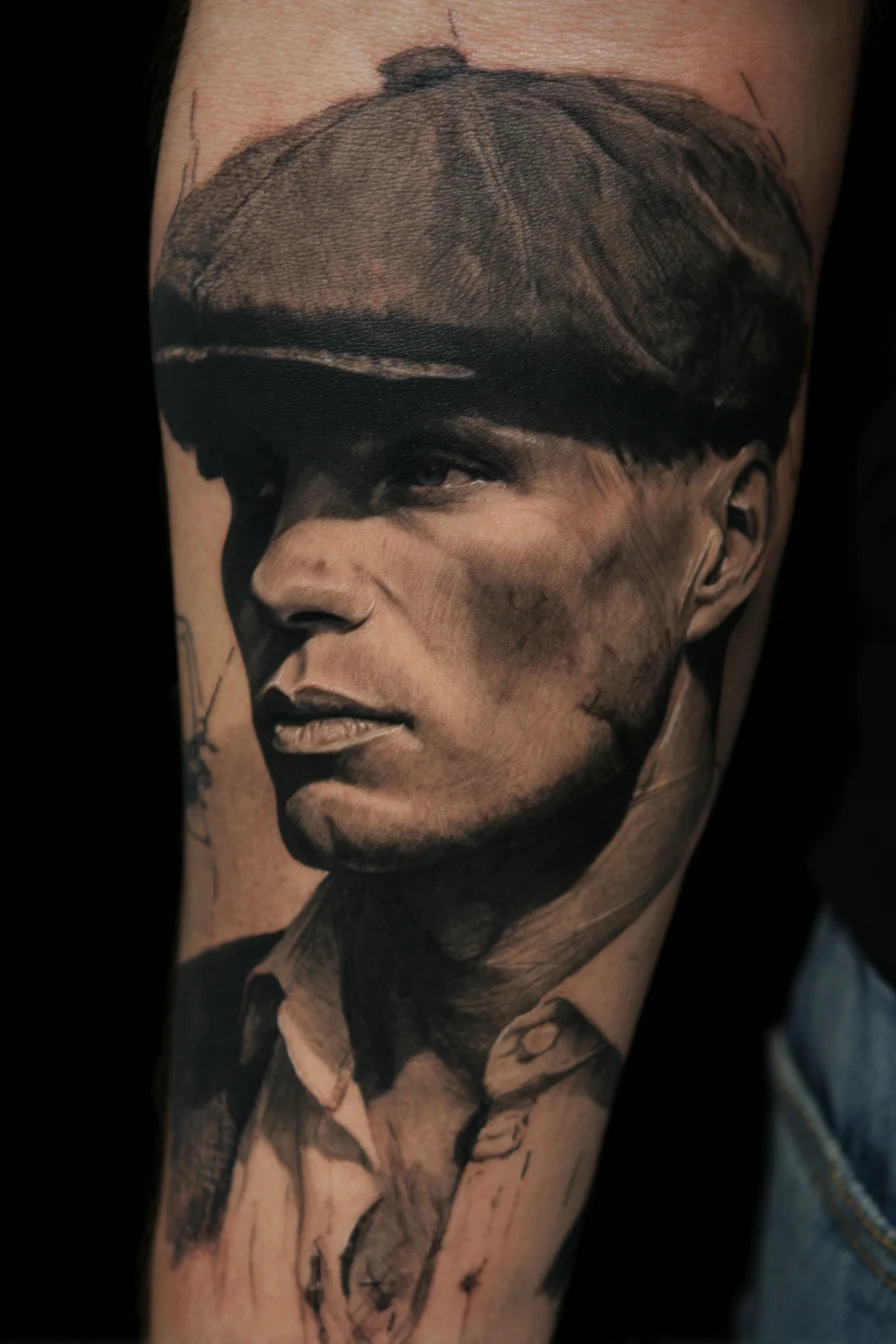
This photorealistic black-and-grey portrait of a man in a flat cap projects stoic, vintage masculinity and can symbolize resilience, family heritage, or admiration for a timeless aesthetic. As a personal piece it reads strongly as character and presence without overt flashiness. Placement suggestions prioritize mid- to outer-forearm (as shown) for visibility and low-to-moderate pain, upper arm or full sleeve for continuity, or chest/side for a larger, more private canvas. Expect pain to vary by location: outer arm and forearm are generally moderate, inner bicep and ribs are more sensitive, and long realistic sessions increase overall discomfort. Size matters for clarity — photorealism needs room: plan for at least 6–8 inches (15–20 cm) vertical to retain fine facial detail; sleeves or chest pieces allow more nuance. Styling variations include high-contrast black-and-grey realism, subtle selective colour (a muted cap or accent), soft dotwork backgrounds, or geometric framing to modernize the look. Consult a portrait-specialist artist, bring high-resolution reference photos, and budget multiple sessions plus careful aftercare to preserve tonal detail.
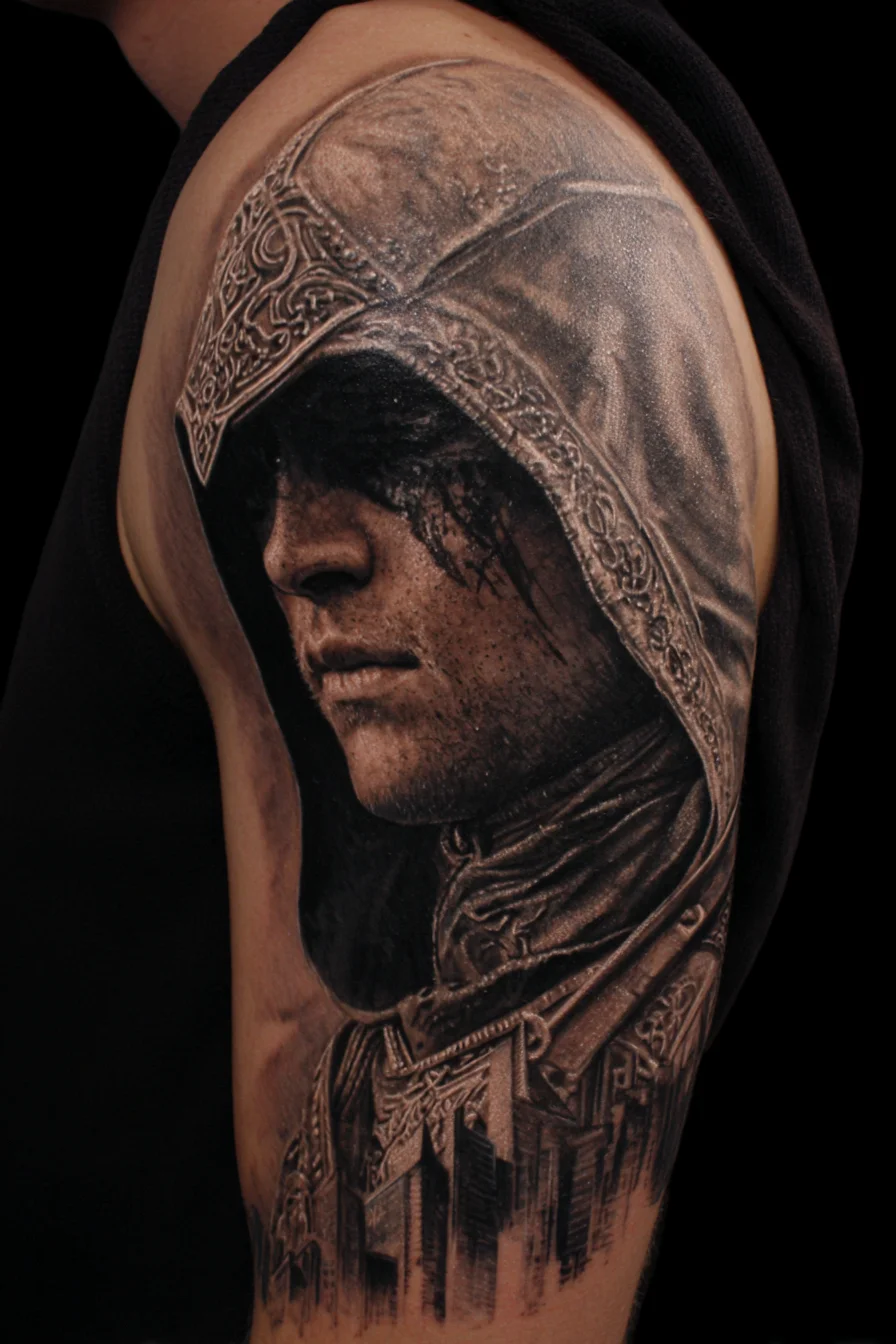
Hooded Warrior Portrait — Black & Grey Realism Upper-Arm Tattoo
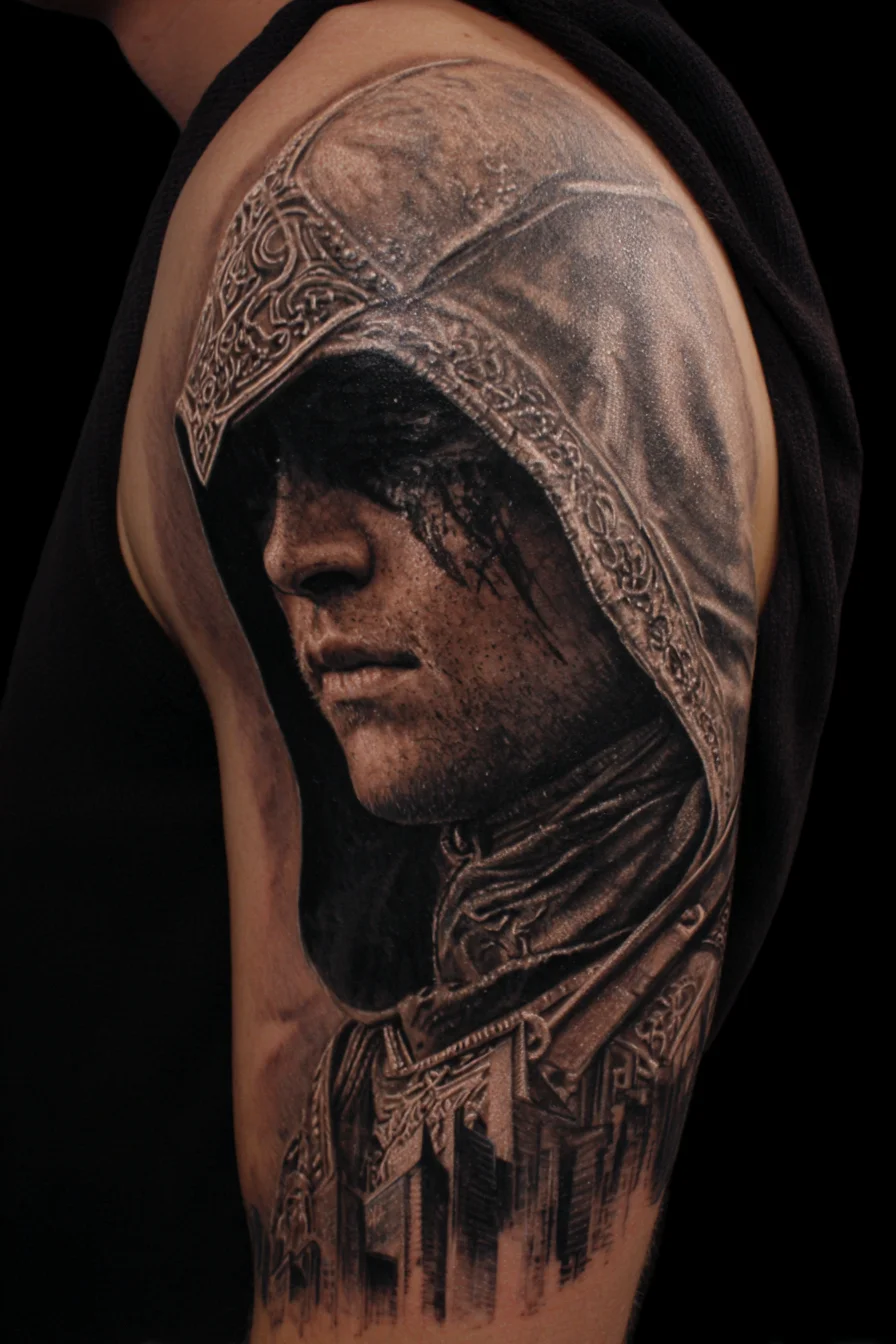
This hooded warrior portrait reads as a statement of resilience, vigilance and controlled mystery. The finely shaded face under a detailed, patterned hood works well as a personal emblem — think discipline, a private code or a guardian archetype rather than a literal identity. Placement suggestions: outer upper arm or shoulder cap for visibility and low movement disruption; expand to a three-quarter or full sleeve to incorporate armor, weapons or architectural elements; chest and back panels are good if you want larger scale and symmetry. Pain expectations: outer upper arm and shoulder are among the least painful areas and tolerate long sessions; inner bicep, near the armpit or close to bone (elbow, shoulder blade edge) is more sensitive. Size considerations: keep this design relatively large (minimum ~6–8 inches) to preserve facial detail and hood texture — portrait realism loses clarity when scaled down. Styling variations: pure black & grey realism (as shown) for a classic look, subtle color accents (blood, metal highlights), dotwork or geometric framing, distressed/ink-splash backgrounds, or full-sleeve integrations with medieval or urban motifs. Consult a portrait-specialist artist and plan multiple sessions for linework and layered shading.
Eagle Head Blackwork Tattoo — Sketch-Style Upper Arm or Forearm Design
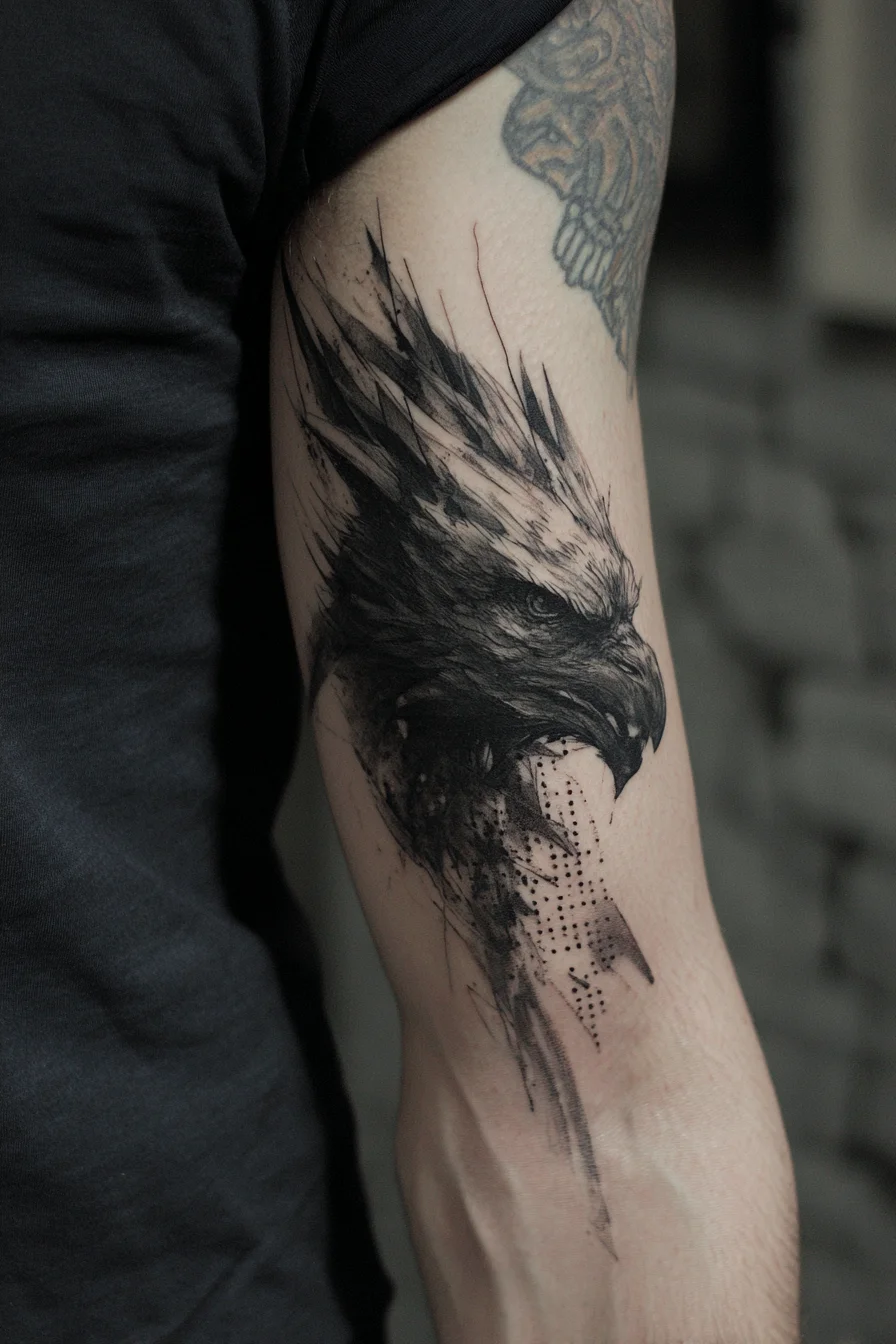
This sketch-style eagle head in blackwork and dotwork reads as a powerful masculine statement: aggression, focus and freedom conveyed through jagged feather strokes and high-contrast shading. Ideal for men who want a bold focal piece rather than a subtle emblem. Placement suggestions include the outer or inner bicep, along the forearm, wrapping the triceps for a three-quarter view, or scaled up to sit on the shoulder and chest for a sleeve transition. Expect moderate pain on the outer bicep or forearm; inner-arm and areas near the elbow or wrist are more sensitive and can increase discomfort. For detail retention, choose a medium to large size — roughly 10–20 cm (4–8 inches) — so the fine sketch lines and dotwork hold over time; scale up if you want this to integrate into a sleeve. Styling variations: pure blackwork for a stark, aggressive look; soft grayscale realism for depth; add subtle color washes (rust, gold) for contrast; or pair with geometric/negative-space elements to modernize the composition. Consult your artist about line weight and dot density to match your skin tone and aging considerations.
Realistic Viking Portrait Tattoo — Norse Warrior Face, Beard & Braids
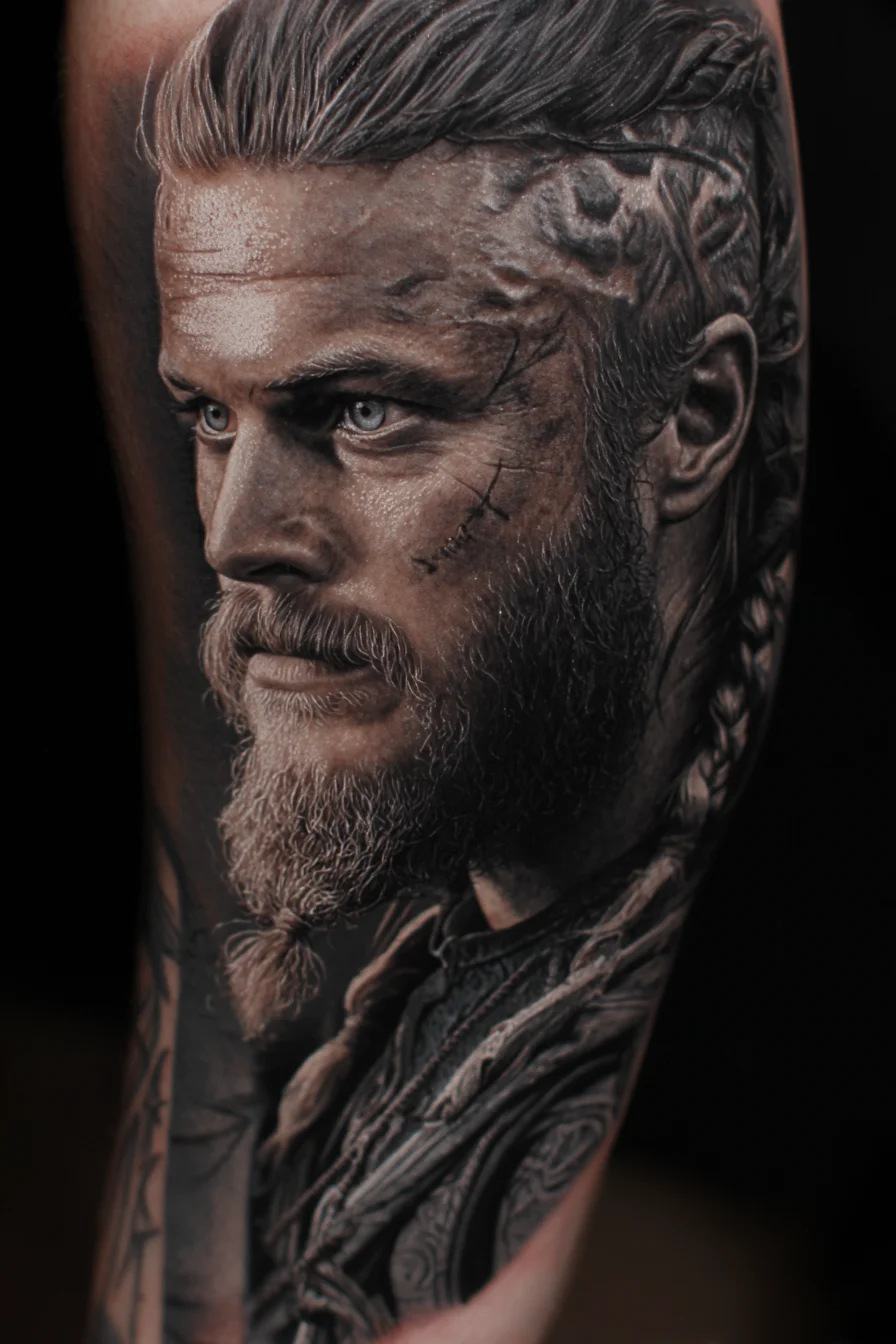
This highly detailed black-and-grey portrait reads as strength, resilience and a connection to Norse tradition — ideal for men who want a powerful, narrative piece. The realistic face, braided hair and textured beard emphasize character and earned scars, symbolizing experience and stoicism. Placement suggestions: full or half sleeve, outer forearm, chest, calf or thigh work best because they provide flat-to-curved canvas and allow scale without distortion. Expect moderate to high pain depending on location — outer forearm and calf are more tolerable, while ribs, sternum and inner arm are significantly more sensitive. Size considerations: for true photorealism plan for a larger piece (minimum 6–8 inches for the head area; 10+ inches for sleeve integration) so fine details like stubble and eyes remain crisp. Styling variations: keep it black-and-grey for timeless realism, add selective color (icy blue eyes or red accents) for focal points, or surround the portrait with Norse knotwork, runes, weapons or weathered textures. Work with a portrait-specialist tattooist, review portfolios, and expect multiple sessions plus strict aftercare to preserve the depth and contrast.
Viking Warrior Blackwork Half-Sleeve Tattoo — Norse Helmet & Beard
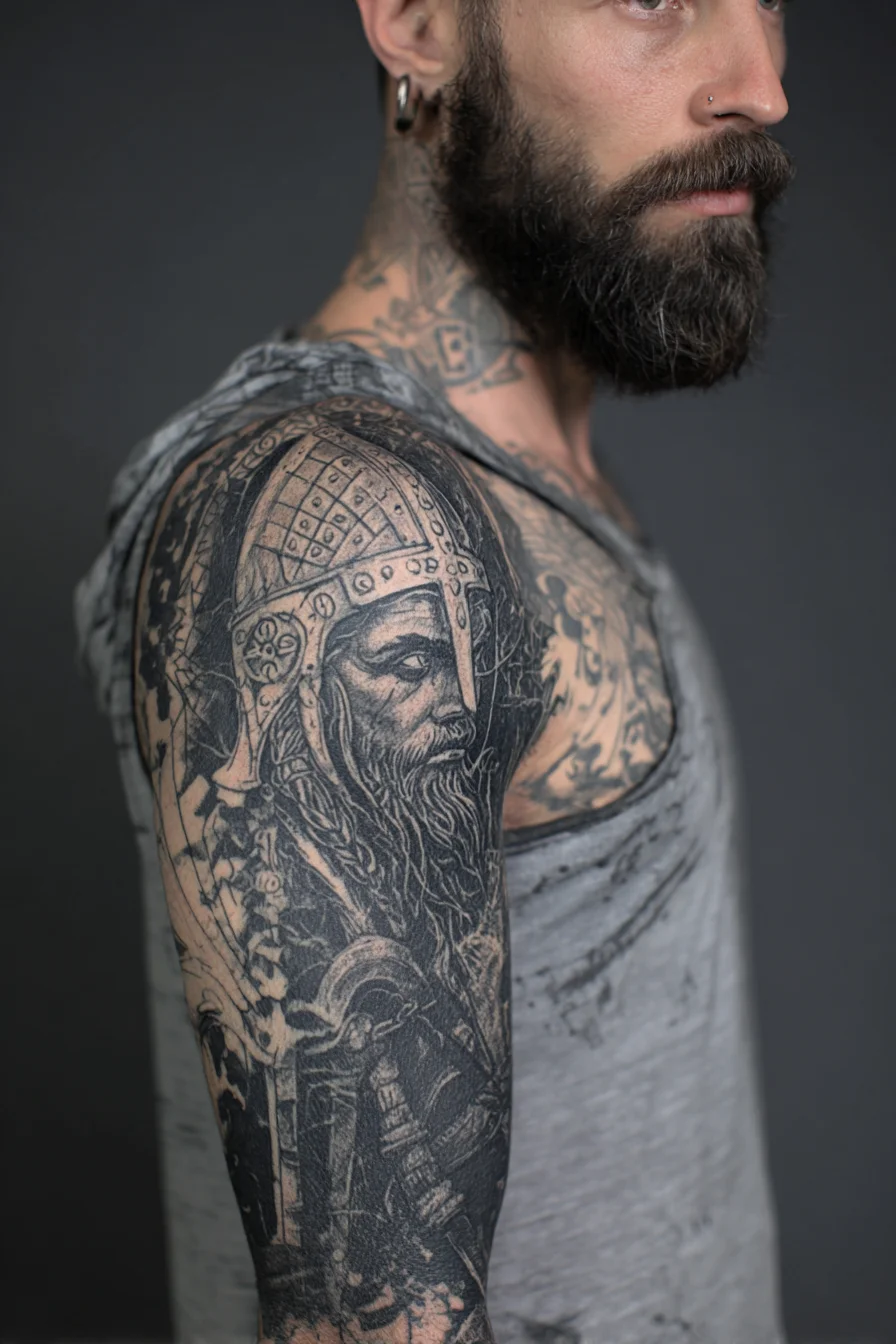
This realistic Viking warrior blackwork half-sleeve portrays a helmeted, bearded Norse figure — a powerful symbol of resilience, honor and ancestral strength. It’s designed for men who want a bold, narrative piece with strong facial detail and ornamental helmet work that reads well from the shoulder down the outer arm. Placement suggestions: outer shoulder and upper arm (half-sleeve) allow the portrait to follow muscle flow; consider extending into the chest, back or forearm for a full-sleeve composition. Pain expectations: shoulder and outer arm are typically moderate; expect increased sensitivity around the inner bicep, elbow crease and armpit. Plan for multiple sessions (2–4 hour blocks) to allow for dense shading and crisp linework. Size considerations: to preserve photorealistic facial features and helmet detail, aim for a larger canvas — at least an 8–12 inch half-sleeve; smaller tattoos will need simplified linework. Styling variations: pure blackwork/grayscale realism, dotwork texture, neo-traditional outlines for longevity, or selective color accents (runes, shields, or banners). Review your artist’s portfolio to match line weight, contrast and healing expectations for your skin tone and lifestyle.
Anatomical Heart Tattoo — Blackwork Sketch with Red Ink Splatter
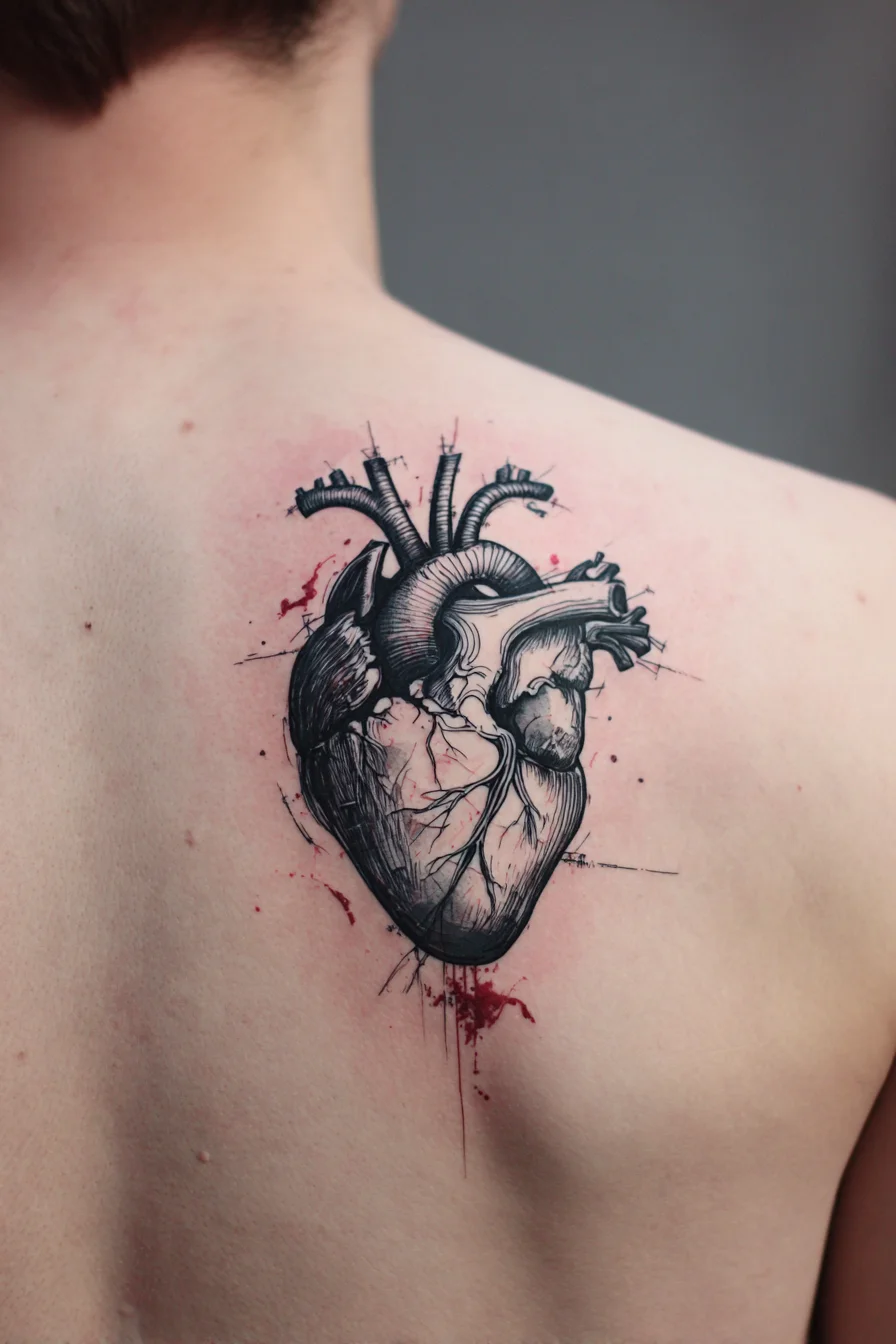
This anatomical heart design combines blackwork linework with sketch-style shading and sparing red ink splatter, creating a visceral yet refined statement about life, passion and vulnerability. For men seeking bold but controllable body art, it reads as strength and emotional honesty without overt ornamentation. Placement: upper back/shoulder blade (as pictured) suits the proportions and hides easily for work; central chest or sternum intensifies the symbolism; ribs or full sleeve integration work well if you want elongation or movement with muscle contours. Pain expectations: upper back and fleshy shoulder are moderate; over the spine, sternum or ribs will be notably more painful due to thin skin and bone; forearm or calf options are generally milder. Size considerations: the pictured medium size (roughly 4–6 inches) preserves anatomical detail; scale up for photorealism or larger back pieces, or simplify linework for smaller placements. Styling variations: full grayscale realism, fine-line dotwork, geometric framing, watercolor red wash, or combined elements (roses, clockwork, script) to personalize. Discuss placement and aftercare with your artist and plan a touch-up for crisp line retention.
Black & Grey Realistic Portrait Eye with Ink-Splatter — Chest/Shoulder Tattoo
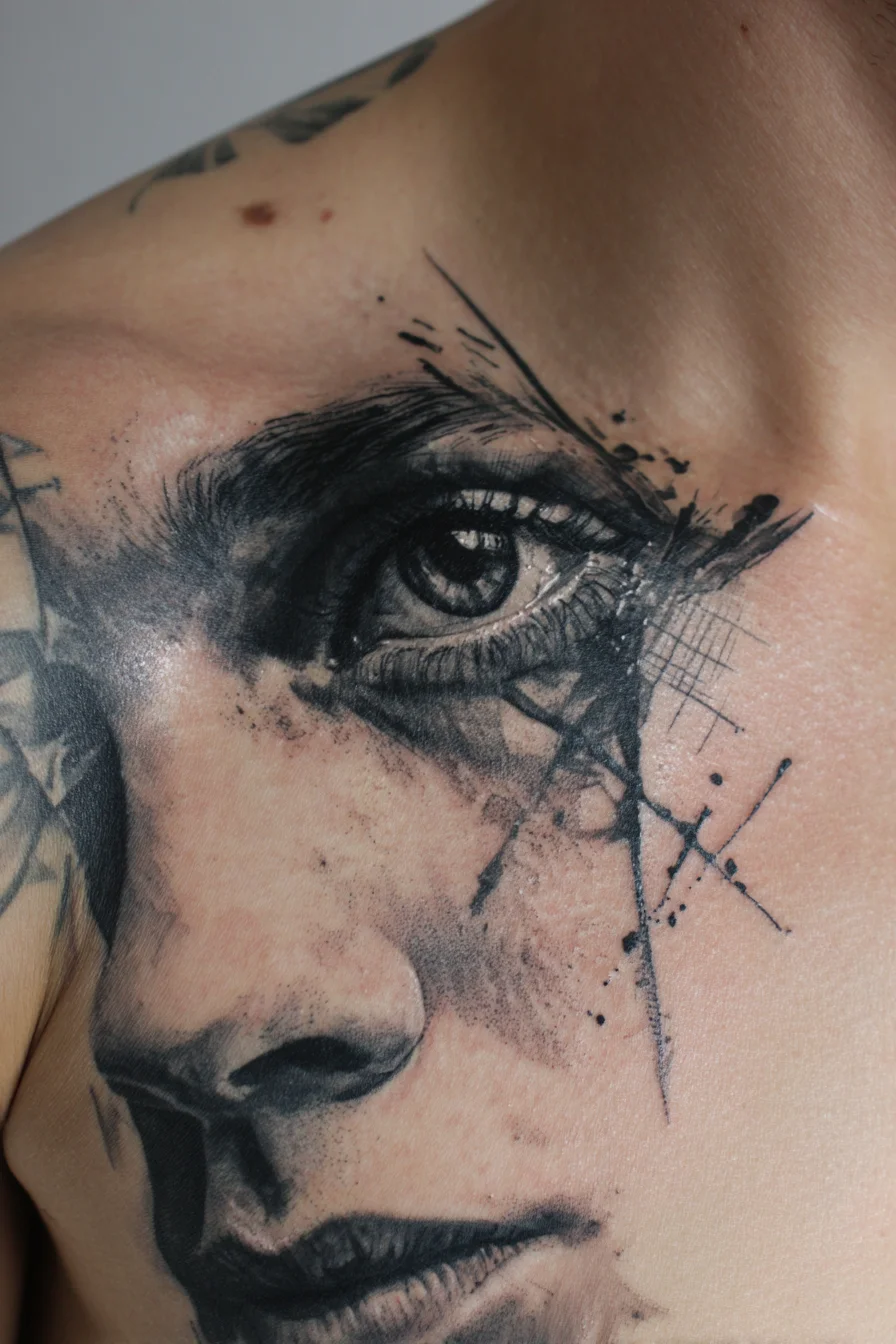
This black-and-grey, hyper-realistic portrait eye with ink-splatter and sketch marks makes a powerful, masculine statement — suggesting vigilance, introspection, protection, or a memory kept close. The expressive realism draws attention while the abstract splatters and cross-hatching add movement and attitude. Placement suggestions: the upper chest/collarbone or sternum (as pictured) creates a bold frontal display; the shoulder cap or upper arm offers a slightly subtler placement; ribs, back or a full-chest extension work well if you want a larger composition or to integrate into a sleeve. Pain expectations: anticipate moderate to high discomfort over bony areas like the sternum, collarbone and ribs; the fleshy shoulder and outer arm are noticeably less painful. Size considerations: realistic detail requires scale — aim for medium to large (minimum ~15–20 cm / 6–8 in) so iris reflections and fine shading read clearly; smaller pieces lose definition. Styling variations: maintain black-and-grey for a timeless look, or add selective color highlights (teal, amber) in the iris or splatter for contrast; consider dotwork, geometric overlays, or fragmented portrait additions for a modern twist. Consult your artist on stencil placement, session breakdown, and aftercare to preserve fine detail.
Black-and-Grey Realistic Portrait Forearm Sleeve — Abstract Fine-Line Tattoo
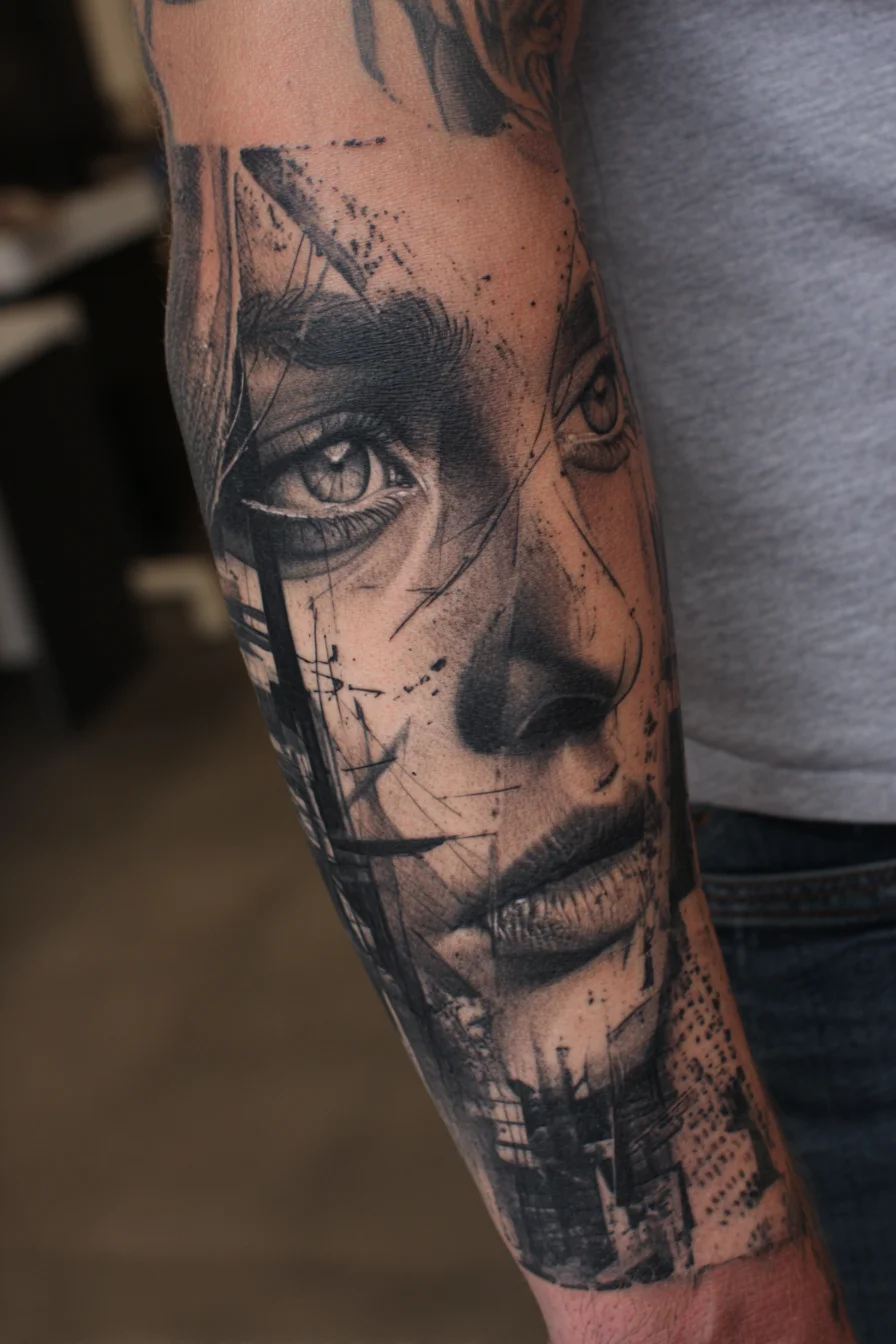
This black-and-grey, photo-real portrait with abstract sketching reads as a story-driven piece — it symbolizes memory, introspection and resilience while the scratched marks add urban grit and motion. For men looking to make a statement, the forearm shown is ideal: the outer forearm provides a flatter canvas and lower pain, the inner forearm lets the portrait face the body but is slightly more sensitive, and extending into a full sleeve or wrapping to the biceps or chest enhances continuity. Expect moderate pain overall: fleshy outer forearm sessions are tolerable, but areas near the wrist, elbow and inner arm increase sensitivity. Because of fine facial detail and nuanced shading, plan for multiple sessions (usually 2–4) and longer appointment times; heavy blackwork and dense shading require extra healing time. Size matters — for crisp eyes and skin texture aim for a minimum of about 6 inches (15 cm) of portrait height; a full forearm piece around 7–9 inches (18–23 cm) gives best results. Styling variations include high-contrast blackwork, sketch/splatter accents, selective color highlights, dotwork backgrounds or geometric overlays to suit personal taste.
Black & Grey Winged Forearm Sleeve — Feathers, Floral and Dotwork
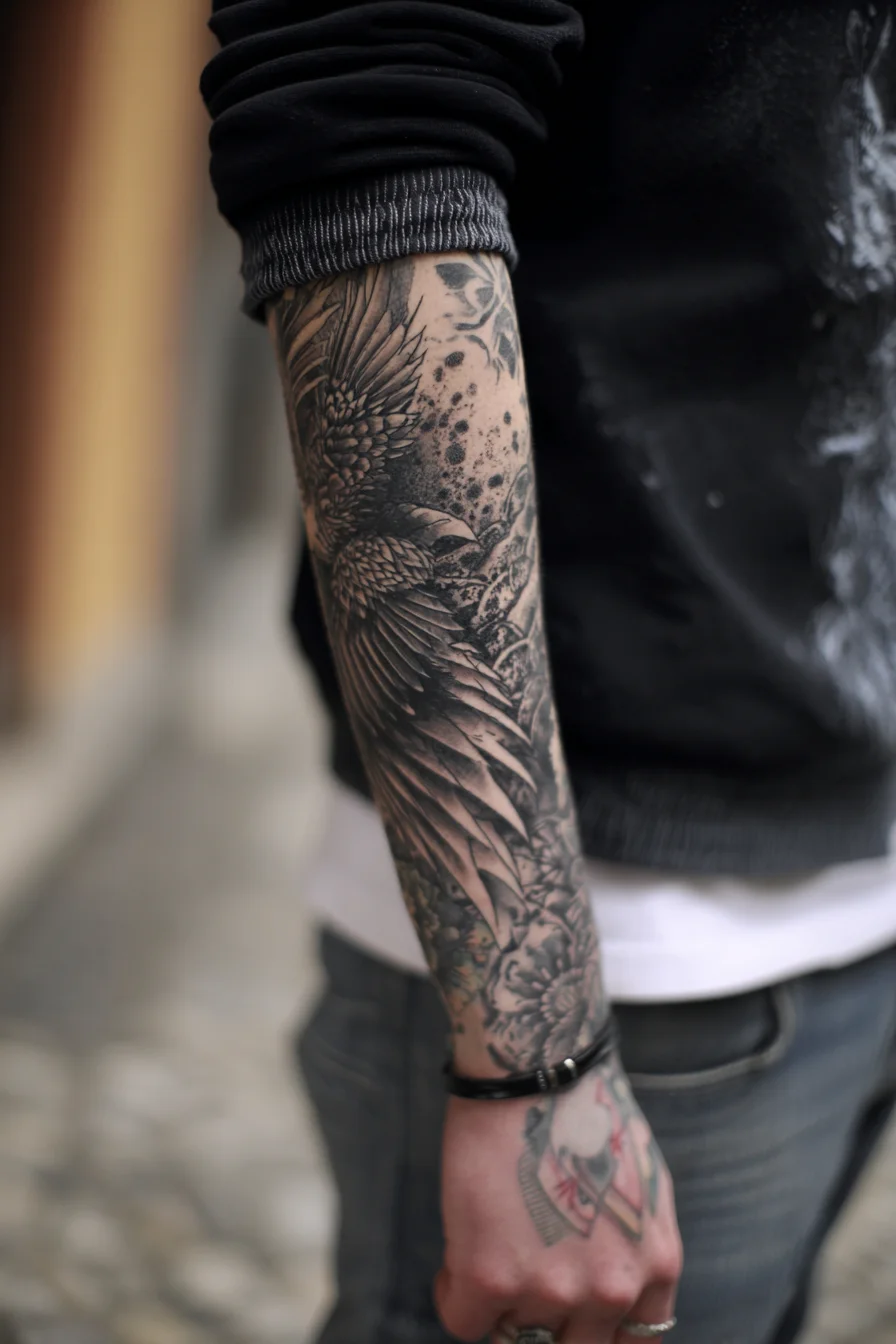
This black-and-grey winged forearm sleeve combines realistic feathers, floral elements and dotwork splatter to symbolize freedom, protection and the balance between strength and growth. As a consult, it reads well as a standalone half-sleeve on the outer forearm or extended into a full sleeve wrapping around the lower arm. Placement: outer forearm offers lower pain and excellent visibility; inner forearm carries more sensitivity but gives an intimate canvas; extending toward the wrist, elbow or chest integrates it into larger pieces. Pain expectations: on a 1–10 scale expect 2–4 on outer forearm, 3–6 on inner forearm and 5–7 near the wrist or elbow bone. Sizes: detailed feather work and dot shading need a medium-to-large canvas—aim for at least 4–6 inches of height for clarity; full forearm sleeves (8–12+ inches) preserve fine texture and age better. Plan multiple 2–4 hour sessions for layering and contrast. Styling variations: keep classic black-and-grey realism or add selective color highlights (red or gold), combine with geometric patterns, Japanese waves, or skull motifs for a tougher aesthetic. Discuss line weight and negative space with your artist to ensure longevity and legibility.
Black & Grey Realistic Male Portrait Tattoo — Smoking Profile
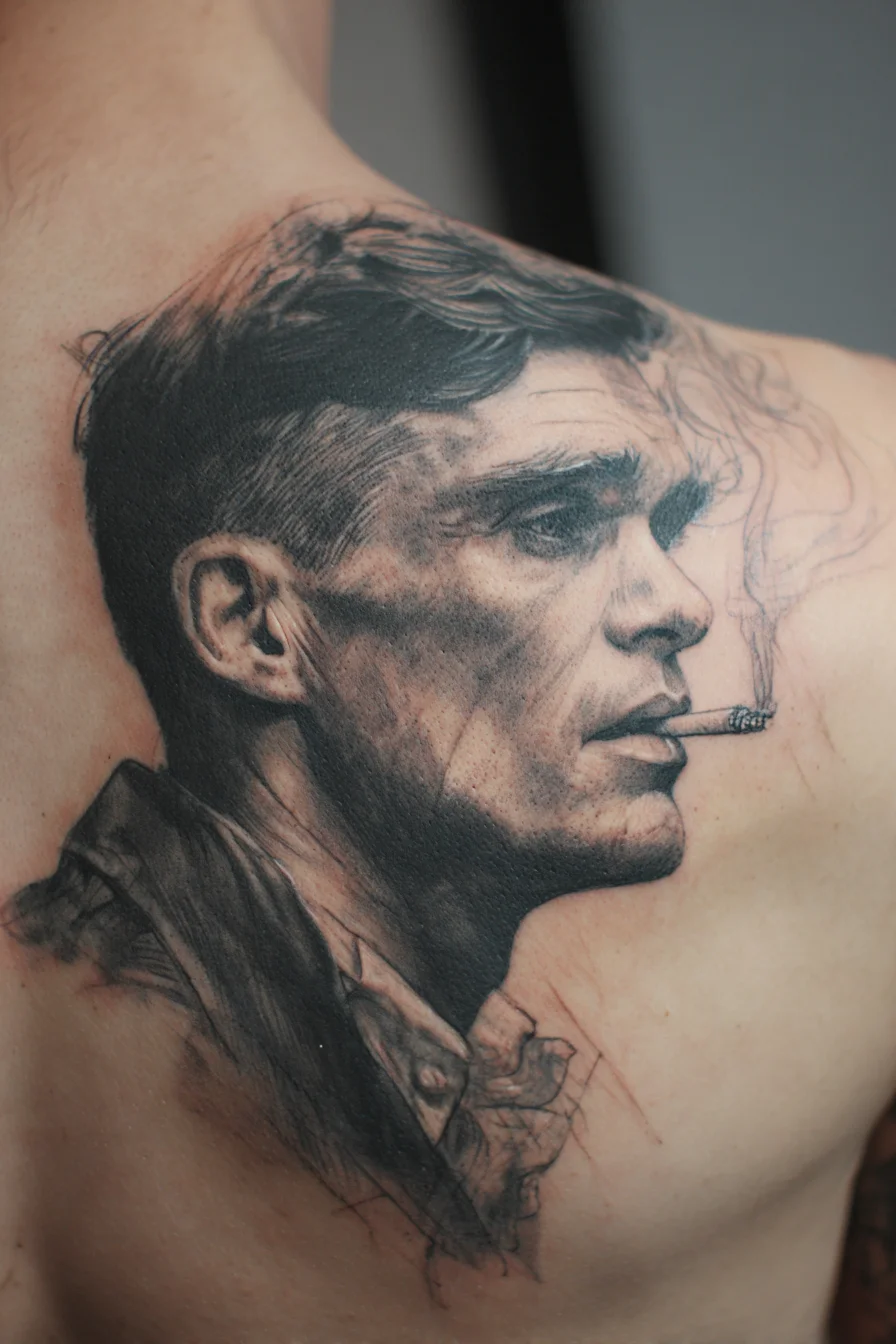
A striking black-and-grey realistic portrait of a male profile with a cigarette, this design conveys stoicism, vintage grit and the sense of a personal tribute without naming anyone. It’s ideal for men who want a character-driven piece that reads as strength, memory or a mood rather than an emblem. Placement suggestions: upper back or shoulder blade to show full facial detail; chest or ribcage for a more intimate, dramatic display (expect higher pain); outer thigh or upper arm for a lower-pain alternative that still holds detail. Pain expectations: moderate on the shoulder/upper back, higher on ribs/sternum and lower near bone, and lower-to-moderate on fleshy areas; deep shading and long sessions increase discomfort. Size considerations: plan medium-to-large — at least 6–8 inches (15–20 cm) across the face to preserve facial realism; optimal detail often requires 8–12 inches and multiple sessions. Styling variations: pure photorealism, sketchy pencil-line edges, selective color highlights (e.g., colored smoke), watercolor accents, geometric frames or integrated script for a memorial effect. Realistic work needs attentive aftercare and occasional touch-ups to retain contrast over time.
Realistic Old Sailor Portrait Tattoo — Black & Grey Upper Arm/Sleeve
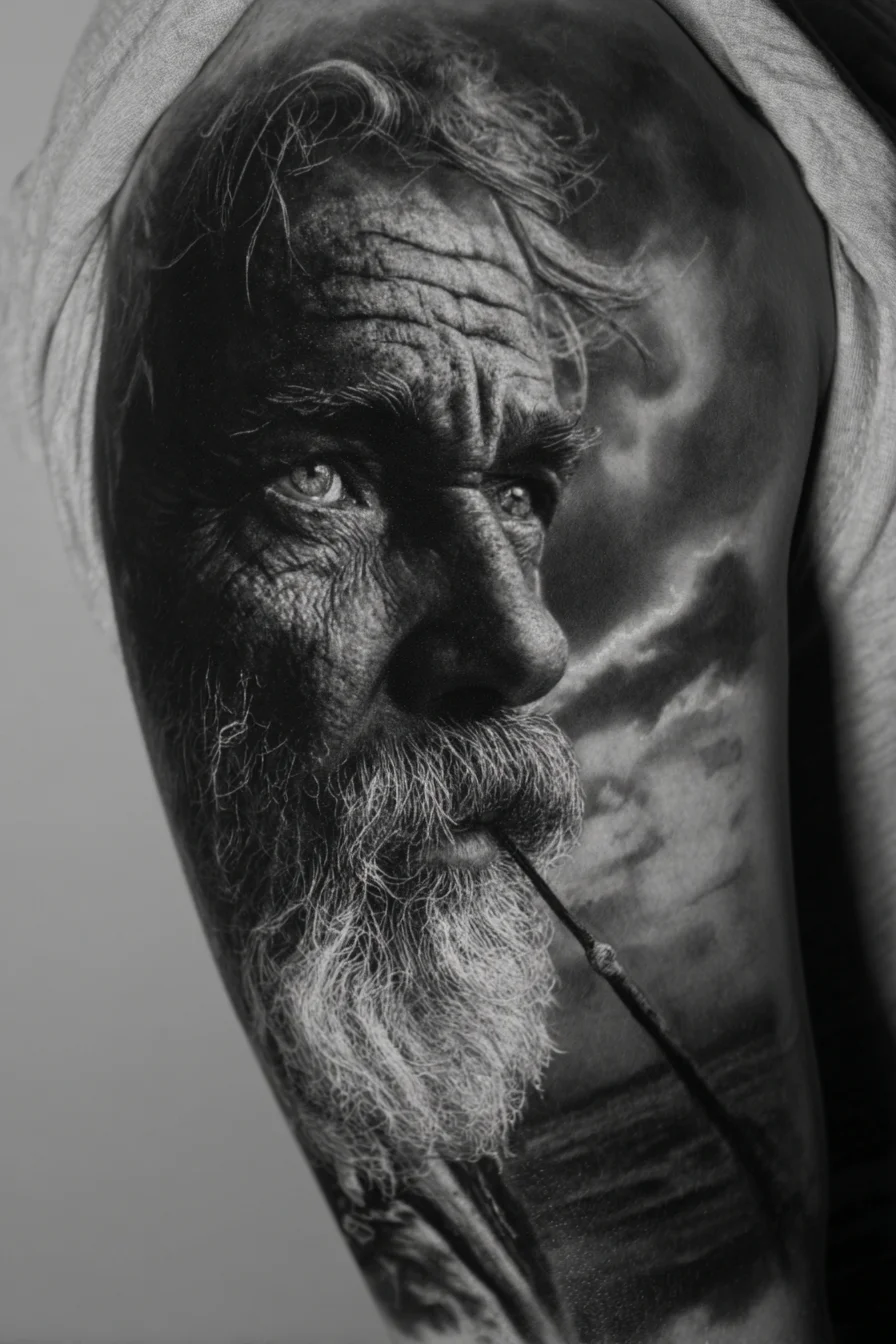
This hyper-realistic black and grey portrait captures the weathered face of an older seaman, conveying experience, resilience and a life tied to the sea. As a masculine statement piece it works best as an upper-arm/shoulder sleeve, full sleeve, or chest panel where the facial detail and soft background clouds can breathe. Expect moderate pain on the outer upper arm and shoulder; more discomfort will occur if you extend toward the inner arm, elbow or ribs. Because photorealism relies on fine shading and micro-contrast, plan for multiple sessions (commonly 2–5 sessions of 3–6 hours) to preserve depth and avoid overworking the skin. Size considerations: to retain crisp detail a larger canvas is recommended — at least 6–8 inches high for a forearm piece, 10–14+ inches for a sleeve. Choose an experienced portrait artist skilled in black-and-grey realism and request high-resolution reference photos. Styling variations include adding nautical elements (rope, compass, ship), converting to a full sleeve with seascape background, integrating subtle color highlights, or framing with dotwork or geometric borders. Expect long-term maintenance: yearly touch-ups and diligent sun protection to keep contrast strong.
After a decade consulting on men’s tattoos, the clearest advice I give is this: plan thoughtfully, choose skill over speed, and protect your investment. Use the 32 images here as starting points — not prescriptions. Bring the strongest references to a consultation, discuss scale so the piece reads well from a distance and ages gracefully, and ask an artist for a stencil to preview placement. Prioritize a hygienic, licensed studio, check healed photos in portfolios, and budget for touch-ups or multi-session builds for larger realism or color work. For immediate practical guidance: shave the area only if instructed, follow the studio’s aftercare (cleaning, ointment, sun protection), avoid soaking while healing, and hydrate your skin long-term. If you have doubts about visibility for work or long-term commitment, consider a placement that’s easy to conceal. When you’re ready, book a consult — great tattoos start with good planning and a trusted artist.
